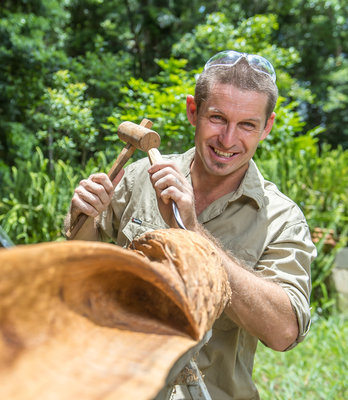
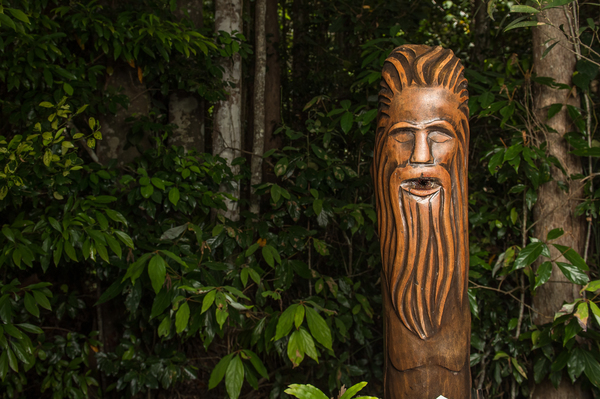
We’ve heard the powerful and spine-chilling roar of a chainsaw in horror movies and for those living on acreage properties, the sound is synonymous with weekend life and the smell of bonfires, but from a little shed in the back hills of Yandina, the buzz of a STIHL MSA200 battery chainsaw is the sound of Shane Christensen hard at work.
Okay, to be clear, Shane’s chainsaw is pretty quiet, so he doesn’t fill the forest full of roaring noises, and he assures me his neighbours still invite him over for drinks.
After 20 years of carving sculptures with chisels and a dremel, Shane pulled the chainsaw chord and went bigger.
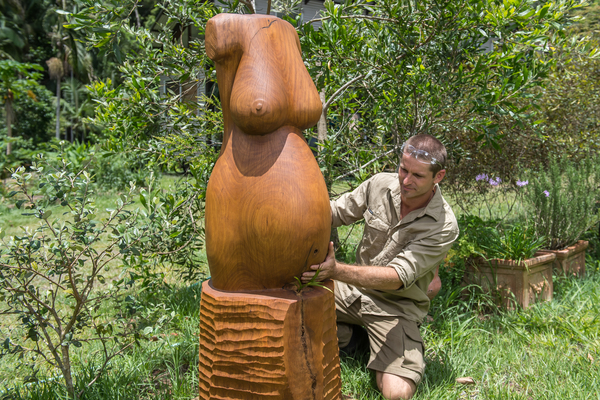
Shane has now carved hundreds of sculptures out of local hardwoods.
“I’ll travel anywhere in Australia or abroad to create a sculpture for a private collection or public piece, or even live carving demonstrations,” said Shane.
“So far, I’ve carved in New Caledonia, Skyhigh in Victoria, and various country shows and events in SEQ and central QLD. I’ve performed about a dozen live sculpting events so far, and I’m full-time sculpting now, carving orders for private commissions.”
Shane has lived in the area for 20 years, and worked in conservation and land management for Noosa Council, Landcare, NICA, and various environmental groups, so most of his sculptures have a deep connection with our local environment, wildlife and local landscapes.
His work has taken another environmental turn which is creating a real buzz (couldn’t resist). Shane is making spectacular pieces which go beyond just the aesthetics. Creating wooden sculptures that accommodate Australian stingless bees and solitary bees for pollination and honey production, other-wise known as sugarbag.
Native stingless bees are important pollinators of Australia’s unique wildflowers and are a vital part of Australia’s bushland ecosystems.
Australian Gumtrees (Eucalyptus sp) provide food and shelter for many species of native Australian, stingless bees. The sculptures are hollowed out, for a colony of stingless bees to inhabit through an entrance in the mouth or belly.
“The timbers I use are local hardwoods, usually waste product from development. These trees used to be habitat for wildlife, including native bees.
“I love installing a box hive of native bees inside some of my sculptures, this is where they used to live, and the bees literally bring the sculpture to life,” Shane said.
“I’d say about a quarter of my work is made for native bees, and I’ve been collaborating with Tim Heard, bee scientist from sugarbag bees.
“Tim has been great to collaborate with, merging practical science with expressive art, for me it connects the two hemispheres of the brain, the logical side and creative side.”
So, what are stingless bees?
Australia has eleven species of small black stingless bees. They are about 4 mm long, much smaller than the bees we think about with a stinger. Some species are black with white fur on their faces and sides. Other species are black with tiny yellow markings on their backs. They build resinous nests inside hollow trees.
Stingless bees are tropical. So they only thrive in warm areas of Australia such as Queensland, northern areas of WA and NT, and north-eastern areas of NSW.
Native stingless bees can be kept in a natural log or in a hive box in suitable parts of Australia. These bees are easy and safe to keep in your backyard but you need to learn about their special requirements.
Stingless bees only produce small amounts of honey – less than one litre per year. However, this honey (known as sugarbag) is delicious and tangy! It is possible to harvest small amounts of honey from suitable hives in warm parts of Australia.
Native Australian bees have been known to build in places that often aren’t the best choice and sometimes in summer their hives melt away. Some of these are: steel drums, compost bins, plastic planter boxes and of course water meter boxes.
Enter Shane and his Stihl MSA200 and his lovingly carved hives. (Which, by the way, his chainsaw charges from solar panels, and uses canola oil in the bar.)
There are a few guidelines to creating a sustainable hive. It must be out of full sun, especially in summer with morning or afternoon sun or in Winter should have sun all day (if possible), away from high wind, not overly bushy locations, where spiders can build webs to catch your bees. A location free from surfaces where geckos and other unwanted pests can easily bridge across. Somewhere you can keep an eye on it if something goes wrong and it must be secure so possums and cats do not knock it over.
“Three of my larger stingless bee sculptures have come through Tree Place, a huge collaborative arts project, that is currently exhibiting at Noosa Regional Gallery,” Shane said.
When Noosa artist Anne Harris followed the fallen form of an ancient tree to the local rubbish dump she decided to salvage it rather than watch it be chipped.
This was the catalyst to Tree Place, and exhibition involving 25 separate creative projects for Noosa Regional Gallery this summer, until 27 January 2019.
And then later, his work will exhibit at the Surf Art Expo, 2-11 March 2019, held at Heads Of Noosa Brewery, in conjunction with the Noosa Festival Of Surfing.
“When I’m not sculpting, I live a simple life spending time with family, friends, bushwalking surfing and snorkelling. We really do live in paradise,” he said.
Why compels Shane to do this work?
“I feel like a sapling in a forest, looking up to the tall trees, they show me what’s possible, ways of creating positive change in this world.”
Perfect.
Find Shane on Facebook @Shane.Artisan