Seven years from the 1972 Olympics, there were no proposals from any cities to stage the event—the reason? East Germany.
International sports federations (now known as GAISF) had agreed in Lausanne, Switzerland in 19655 that the country and city staging the 1972 Olympic Games must issue visas to all athletes entitled to compete. This automatically eliminated NATO countries as possible organisers because they would not issue visas to the Communist-occupied East Germany.
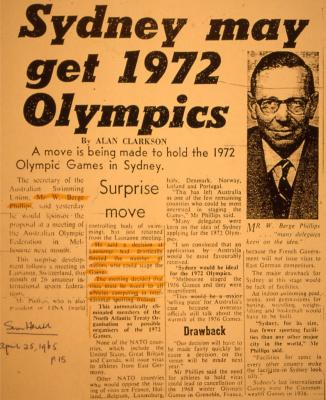
The Secretary of the Australian Swimming Union (ASU), William Berge-Phillips, however, was quoted as saying that “many delegates at the Lausanne meeting were keen on the idea of Sydney applying for the 1972 Olympics.” Avery Brundage, President of the IOC, was receptive to the idea, and his “Sydney can do it” comment was headlined in the Australian press at the time.
The idea, however, was not welcome by the Australian media. The sports editor of Sydney’s Sun-Herald stated on May 2, 1965 that it was “crazy to suggest Sydney could stage the Games on a scale as grand as Tokyo …. to get the Games ahead of other nations whose visa restrictions would rule them ineligible, would be a pyrrhic victory.”
Another journalist, the state political correspondent of the Sydney Morning Herald, pointed out on October 7, 1965 that the Australian Government also had a policy which would prevent the issuing of visas to an East German team. However, the AOF decided unanimously in May 1965 to support an application by Sydney even though it was considered a “calculated gamble.”
A perceived hurdle was the IOC’s decision that all events on the summer Olympic Games program, including equestrian events, must be held in the same country. Readers may recall from last week the equestrian events for the 1956 Melbourne Games were staged in Stockholm, Sweden. However, Hugh Weir, a member of the IOC in Australia, was quoted as saying, “there is nothing at this stage to indicate that the equestrian events will not be on the same program for the 1972 Games.”
This was an unlikely possibility and the Lord Mayor of Sydney, Alderman H F Jensen, suggested that he would ask the Premier (Askin) to make a special grant for the study of exotic horse diseases to help Sydney’s application.
Support for the proposal needed to be forthcoming from both the State and Federal governments before Sydney’s application could be prepared for submission to the IOC by the mid-1966 deadline.
The Sydney Morning Herald’s state political correspondent, under the headline ‘Games Campaign a “pipe dream”, wrote on October 7, 1965 that “the State Treasury is examining an estimate by Alderman Jensen that Sydney could stage the Games for 15 million pounds, and will report to the Premier, Mr Askin … But this proposal, in view of the political as well as the financial problems, looks to be moonshine.”
Eventually, the NATO issue relating to visas was resolved to the satisfaction of the IOC and Munich in West Germany was approved to stage the 1972 Games.
Sydney was again early off the mark to link hosting an Olympic Games with Australia’s 1988 Bicentennial Celebrations. A formal policy announcement by the newly appointed Minister for Sport in NSW, Eric Willis, was published in the Olympic News – a NSW Olympic Council bulletin – in March 1971. This bulletin also reported that Sydney’s Lord Mayor had formally written through the AOF to the IOC to host the Games.
A ‘Citizens of Sydney 1988 Olympic Games Committee’ was appointed with the Deputy Lord Mayor, Alderman Nicholas Shehadie (a former Rugby Union great) as chairman. Other members comprised community and business leaders.
Sports journalist and author, Jim Shepherd, was pessimistic about Sydney’s chances. Under the headline ‘The Olympics for Sydney – not very likely, Mr Wills (sic)’, wrote:
“Australia has staged the Olympic Games once – in Melbourne in 1956 … Less than 12 months before the opening ceremony building was drastically behind schedule and at one stage, the Chairman (sic) of the International Olympic Committee, Mr. Avery Brundage, threatened to take the games away from Melbourne … Those memories have faded for all but the International Committee. It is highly doubtful if Melbourne would ever be considered as a future host city.
“Sydney’s situation is hopeless, ludicrous, in comparison. … The very day he [Willis] praised the ‘Olympics for Sydney, 1988’ slogan he admitted that he had no budget, no firm ideas about raising money to assist sport and ‘no bright ideas’ about developing Sydney as an Olympic venue.”
Another committee was formed seven years later in November 1978 to advise the NSW government under Premier Neville Wran on the feasibility of bidding for the 1988 Olympic Games. The report of this interdepartmental committee, entitled ‘Records relating to a proposal to hold a 1988 Olympic Games in Sydney’, persuaded the government to decide
not to proceed as the likely $2 billion cost was beyond the resources of the State.
The then current IOC member in Australia, Phil Coles, has stated that the Games climate then was very different because “this wasn’t long after Montreal’s Games (1976) and the financial problems they were experiencing were very public.”
Sydney’s proposal fizzled, but Melbourne stepped forward and its bid to the IOC to stage the 1988 Olympics was endorsed by the AOF in 1980. The federal Minister for Home Affairs, Robert Ellicott, announced in September 1980 that the Federal Government had established an interdepartmental committee to examine the proposal, which had been made public by the former Melbourne footballer and then Victorian Minister for Youth, Sport and Recreation, Brian Dixon.
An Australian delegation presented Melbourne’s case to the General Association of GAISF in Monaco in October 1980. Dixon remained confident of Federal Government support, and it was promulgated that the ‘Olympic Games for Melbourne Committee’ would send a delegation to Lausanne in late February 1981 to speak with IOC officials.
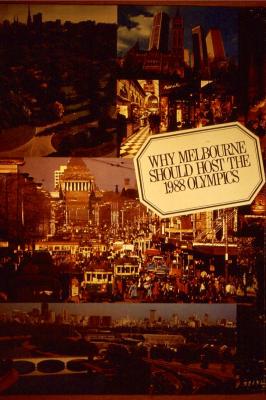
A glossy booklet outlining Melbourne’s venues was in the final stages of preparation amidst speculation of whether the Federal Government would meet half the $767 million cost of staging the Games and take a share in the estimated $642 million revenue.
There was no trip to Lausanne. Federal Treasurer, John Howard, announced on February 24 1981 that the necessary funds would not be made available. Premier of Victoria, Dick Hamer, stated that it had been agreed by the two governments that Melbourne’s bid would not proceed.
Former Jamaican sprint champion and Olympian, and then sports journalist in Australia, Mike Agostini, wrote that the Fraser Government’s rejection of the Melbourne bid was a blessing in disguise, “most of all for the Australian taxpayer”:
“While the Victorian Committee … conservatively estimated a deficit of only $144 million, the more realistic estimate by the Federal Government was much higher – at a staggering $500 million’.47 A Morgan Gallup Poll reported that only 51 per cent of Melbourne citizens favoured their city hosting the Games with 41 per cent against and 8 per cent undecided. Of those under the age of 30, 73 per cent were in favour.”
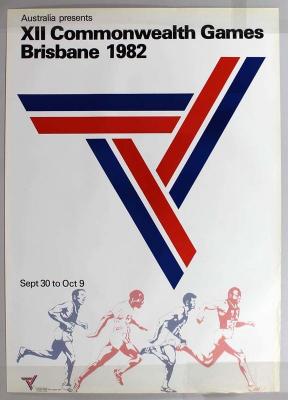
NEXT WEEK: Australia’s brilliant major sports event – the 1982 Brisbane Commonwealth Games – mobilises a proposal which transitions into a formal bid for Brisbane to host the 1992 Olympic Games.
(Ian Jobling is Honorary Director of the UQ Centre for Olympic Games at The University of Queensland)