
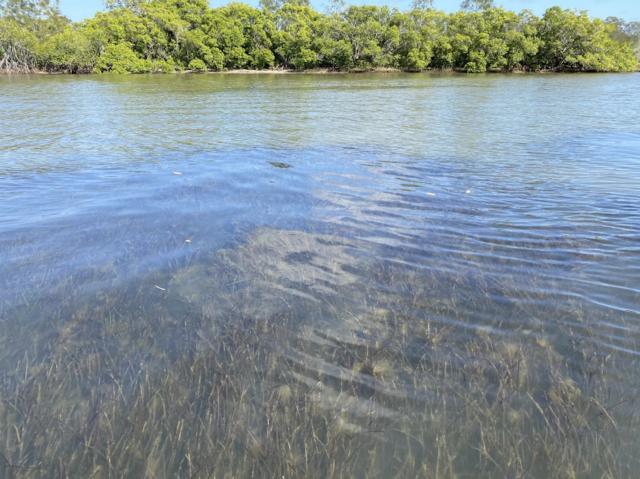
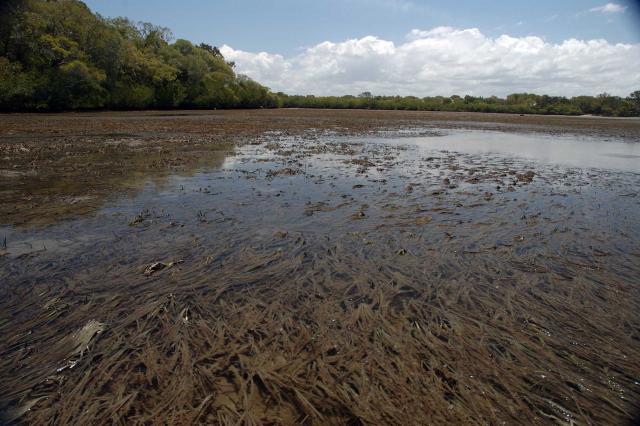

Noosa River estuary has lost more than 80 percent of its seagrass over the last 33 years and it shows no sign of recovering, according to an alarming new report.
The Noosa River Estuary Seagrass Distribution Study 2021, prepared by Ecological Service Professionals for The Nature Conservancy, notes that in 1989 there were 337.4 hectares of seagrass in the estuary but by 2006 just 53.7 hectares. After a slight recovery, the coverage had dropped back to almost that level (56.1) by 2020.
Storms and flooding are the most likely cause of the disappearing seagrass meadows, but the big question is what is preventing their recovery in the Noosa River? ESP principal ecologist Dr Simon Walker, author of the study, says: “Recovery from impacts such as flooding in other similar seagrass meadows has occurred within a few years. This is not the case in Noosa.”
The importance of seagrass is that the meadows help to sustain the biodiversity of the river by providing food and shelter for a wide range of marine fauna which in turn provides food for many larger, commercially and recreationally important species of crustacean, mollusc and finfish. In other words, less seagrass, less seafood stock.
Noosa’s seagrass meadows have been challenged for a century and a half, since the late 1800s when the upriver timber industry caused the release of large quantities of sediment into the estuary. The situation escalated after World War II as farms became more mechanised and the family tractor could push further up the slopes, and every time it rained a mountain of mud would head downstream. Then as now, this process released high levels of suspended sediment into the system.
The concerning factor about Noosa’s depleted seagrass is that while neighbouring areas, such as Great Sandy Straits and Moreton Bay, seem able to regenerate over a few years, the long-term evidence now is that ours cannot, and the experts don’t yet know why. Says Simon Walker: “Because of their importance for estuarine ecosystems, the precise drivers for the decline and lack of recovery of the Noosa River Estuary seagrass meadows need urgent investigation. Better understanding of the Noosa River system would advise river managers who could advocate for resources to enable research and recovery action.”
Noosa River Stakeholder Advisory Committee member and vice-president of Noosa Parks Association Dr Michael Gloster said one hypothesis is that over the past century and a half sediment had gradually accumulated in the system, and a tipping point had been reached sometime in the past 30 years, with high levels of sediment blocking recovery.
Noosa Today understands that the expert advice is that the seagrass depletion issue needs the development of small, targeted and experimental responses rather than large-scale intervention, which would be expensive and possibly counter-productive. One theory is that Noosa’s problem with recovery relates to the fact that the river has several different species of seagrass in different areas, as well as different mixes of different types of sediment in different areas, so one fix doesn’t fit all.
Dr Gloster told Noosa Today that the worst outcome from the release of the report would be that nothing is done. “Previous reports on the health of the river have ended up gathering dust on council shelves. That can’t happen this time. It’s really important that council retains The Nature Conservancy to commission ongoing research work to better understand what’s stopping the natural regeneration that’s happening in neighbouring areas. It’s also vital that council retains TNC to do targeted trials on remediation.”
The current three-year TNC contract with council to commence oyster reef recovery in the Noosa River by constructing four new reefs between Tewantin and Noosa Heads, and to provide expert scientific advice to council on related issues such as seagrass, is up for review in the middle of this year. Interestingly, earlier oyster reef trials in the river showed that they helped stabilise the sediment in the water, and the seagrass started to grow back in adjacent areas, so the issues are closely linked.
Dr Gloster said he was cautiously optimistic that councillors would support further river studies since several of them, Mayor Stewart included, had already started to play a more proactive role in managing the river. “Over the next few months, we’ll see how serious they are about that,” he said.