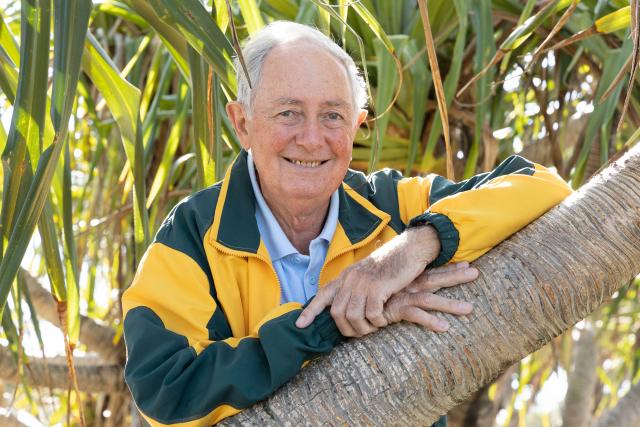
Australia’s environment “is crook and getting worse“ according to Professor Ian Lowe AO whose book titled “Australia on the Brink: Avoiding Environmental Ruin“ paints a dismal picture of the state of our environment but is not without hope for the future.
His short but powerful book is one in a series of about 30 “In the National Interest“ books written by invited authors and put together by Monash University to “extend knowledge and encourage informed debate about matters of significant interest to Australia’s future“
Prof Lowe, a Noosa resident, with a long career in universities, research councils and advisory groups, chaired the first independent national report on the state of Australia’s environment in 1996 and found that we faced serious problems. Top of the list was our unique biodiversity, he said.
“Since 1788 we’ve lost 30 mammal species and 29 bird species – that’s the ones we know of. We’ve almost certainly lost others we don’t know of,“ he said.
“We know what causes species extinction – loss of habitat, introduced species and chemical pollution.
“You don’t know the significance of something until it’s gone. There are impacts up and down the food chain. You only find out later what the impacts are.
“We’re pulling random bricks out of the wall of life, but although whole sections are going to collapse, our science is not sufficiently comprehensive to be able to predict the consequences. We don’t know what we are losing.“
Significant issues also identified in the report were loss of productive land, state of inland rivers, especially the Murray-Darling system, pressures on coastal zones from population increases and the release of increasing amounts of greenhouse gases contributing to climate change.
Since 1996 there have been five further reports declaring those problems were all getting worse, each calling for immediate action to protect our future.
The 2021 report determined that, ’Overall, the state and trend of the environment of Australia are poor and deteriorating as a result of increasing pressures from climate change, habitat loss, invasive species, pollution and resource extraction,’ and warned of the dramatic impact on our health and living standards, he said.
“It is now clearer than ever that the consequences of long-term inaction are upon us.“
Prof Lowe said on a global scale, a worldwide group of leading scientists published a warning to humanity on the risks to the environment in 1992 and called for an urgent response. None came.
Twenty-five years later in 2017 a second warning was issued, endorsed by more than 15,000 scientists including Prof Lowe which summed up the progress over the past 25 years.
It found fresh water had been reduced per capita by 25 per cent, the world fish catch had shrunk by 20 per cent, the world had lost 100 million hectares of forest area, the number of ocean dead zones had almost doubled, green house gases had increased, climate change was accelerating and the mass extinction of species was at a similar rate to the past great extinction events, such as the one that marked the end of dinosaurs, he said.
The one success was the global response to warnings about a depletion of the ozone layer which led to a reduction in the release of chemicals causing the problem and a stabilising of the ozone layer that is expected to recover in the next 50 years.
“The loss of biodiversity is the most important problem because it is irreversible, but the most urgent task now is to slow climate change,“ Prof Lowe said.
Climate change has resulted in a rise in temperature on the Australian mainland of an average 1.5 degrees compared to 100 years ago and up to 2.5 degrees warmer in the middle of the continent, along with catastrophic fire seasons and floods at increasingly closer intervals, he said.
“The Climate Council estimated the cost over the past five years to be about $22 billion in property damage.“
Prof Lowe said while some respected thinkers see some sort of ruin of civilisation as almost inevitable he does not accept the gloomy conclusion.
“If enough people want change then change happens,“ he said.
In an earlier book, A Big Fix, Prof Lowe sets out a 10-point criteria for a future sustainable Australia that includes reconciling with First Australians, stabilising the human population, approaching zero waste, maintaining existing natural areas, setting serious environmental standards for new developments, being a low-carbon society and a more equitable society.
In his more than 80 years he has seen society make changes seen as utopian when first proposed, and others have occurred throughout history.
No smoking laws, wearing seat belt laws, same-sex marriage and female leaders in politics are just a few changes adopted in his lifetime. Earlier examples including the abolition of slave labour and the vote for women both occurred without the economy or society crumbling as first thought.
“The reason the Sunshine Coast is not like the Gold Coast is because a lot of people have objected,“ he said.
“There’s good things happening.“
Prof Lowe said in response to Professor Graeme Samuel’s 2019 review of our environmental laws that acknowledged the laws were not protecting our environment Environment Minister Tanya Plibersek this year promised to introduce stronger laws designed to repair nature, protect precious plants, animals and places, setting standards that new developments must meet, and establishing an Environment Protection Agency to enforce those standards.
“These are great aspirations, consistent with the National Strategy. It remains to be seen whether this government is able to hold the line against the powerful forces promoting irresponsible economic development,“ he said.
And after a decade of procrastination the federal government has set a target of net zero emissions by 2050, a target that former Australian chief scientist Dr Alan Finkel wrote in a 2021 Quarterly Essay would be difficult but not impossible to attain, he said.
Each of the 84 pages in Professor Ian Lowe’s book is packed with information, providing a very readable account on the state of Australia’s environment.
Australia on the Brink: avoiding environmental ruin is available at Annie’s Books on Peregian.