Renewable energy sources such as roof top solar have their place as part of our nation’s energy mix, but the rapid rate of industrial scale renewable energy projects and their associated transmission lines are taking a devastating toll on private property, prime agricultural land, wildlife habitat and the environment in regional communities.
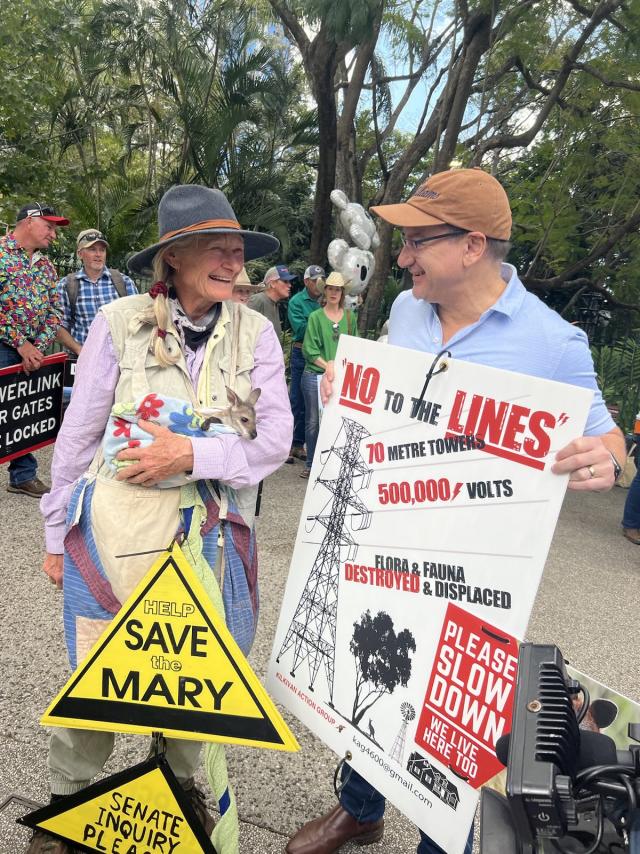
On 22 August, I spoke at the Rally Against Reckless Renewables at Parliament House in Brisbane to voice my concerns about the impacts of the Albanese Government’s $80 billion plan to carve up to 28,000 kilometres of new high-voltage transmission lines through regional areas to link industrial sized, land-intensive solar, wind, and pumped hydro to the grid.
Currently, renewables supply about 30 per cent of our electricity. To meet the Albanese Government’s renewable energy target, this will need to almost triple to supply 82 per cent of our electricity by 2030.
This level of renewable reliance is not achieved by any comparable country, with Iceland only achieving 80 per cent because of its huge capacity for hydro – and Australia is the driest inhabited continent in the world. This weighting of renewables is not something that should be rushed into, and these are not projects that should be given the green light just because they claim to be renewable.
Indeed, so called green energy does not come free from environmental consequences. We need to pause and plan and ensure these projects have a social license first.
Wide Bay is currently a major battleground where local property owners are standing up for their rights over two renewable projects.
The Borumba Pumped Hydro project in the pristine Mary Valley will dramatically impact the local habitat of endangered and critically endangered fauna and flora, including the northern quoll, koala, and native guava.
The ill-fated Traveston Crossing dam was cancelled due to the impact on endangered flora and fauna, and the Queensland Government says forests such as those under the proposed Powerlink transmission corridor are important for wildlife conservation. Yet the Queensland government owned Powerlink corporation says these trees that property owners are unable to touch must be ripped out to plant transmission towers.
Transmission lines from the Borumba Pumped Hydro proposal would impact more than 200 freehold properties from Borumba through the South Burnett and Kilkivan to Woolooga and destroy up to 83 kilometres of native forest. A corridor would be bulldozed through these properties and 70 metre high, 500 kilovolt power pylons made of 75 tonnes of steel with 20 metres of concrete foundations, will cobweb the rural landscape.
The Forest Wind project is a proposed 226 mega turbine wind farm located in the pine forestry between Maryborough and Gympie, with high voltage transmission lines connecting through Anderleigh and Curra to the sub-station at Woolooga.
Residents in these areas have received notification that a 60-metre wide transmission line corridor could run through their rural properties, and transmission towers built in proximity to their homes.
These projects have exposed a clear power imbalance between property owners, and the Queensland Government and big energy companies that are threatening to compulsorily acquire and access private land.
If they proceed, these projects and their transmission lines would take a permanent toll on the amenity of regional communities, the landscape, natural habitats, and heighten bushfire risks.
You can be assured that if an industrial scale solar farm or wind factory is proposed for Noosa, I will fight it just as vigorously.
There have been five recent attempts by the National and Liberal Parties to initiate a Senate Inquiry into the impacts of high-voltage electricity transmission infrastructure, and each of these attempts have been blocked by Labor and The Greens political parties and the Independent Senator David Pocock.
The Queensland and Federal Labor Governments seem to think if we build lots of wind, solar, and pumped hydro, energy will be cheaper, but that’s not the current lived experience. We have never had more renewable energy in the grid, yet our power bills have never been more expensive.
Australians are now amongst those paying the highest power prices in the world for electricity.
The Queensland Government’s proposed Borumba project starts out as one of the most expensive taxpayer funded renewable projects in Australia. Borumba’s $14.2 billion price tag does not include the cost of the compulsory acquisition of land for the transmission towers, nor the cost of the required upgrades to the Woolooga power station, and the cost blow outs associated with projects of this size.
At full capacity, Borumba will only be able to generate 2000 megawatts for 24 hours. In contrast, Snowy 2.0, comes in at $10 billion and can supply electricity for a week.
It’s time Australia started a sensible national discussion about reliable next generation zero emission nuclear power and examine other countries that are making decarbonisation work by having nuclear in their mix, and cheaper power bills as a result.
There’s a reason so many countries are embracing next generation zero emission nuclear energy. It gets power prices down, and it decarbonizes economies without weakening those economies. And it can be done using existing transmission networks.
Our country has an abundance of natural resources and the cheapest, most reliable, emission free and lowest community impact sources of electricity should be available to us.