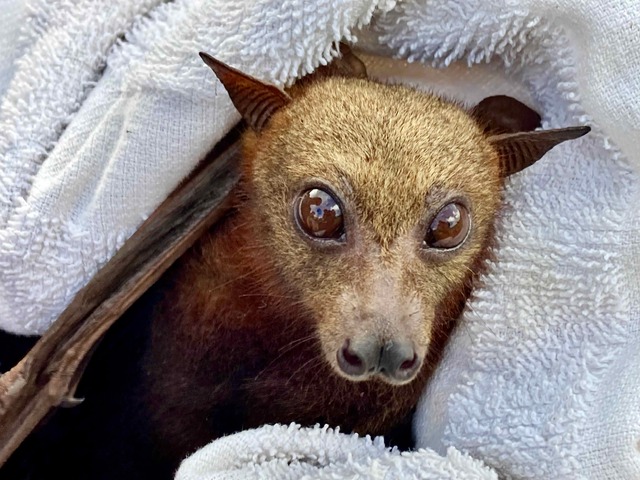
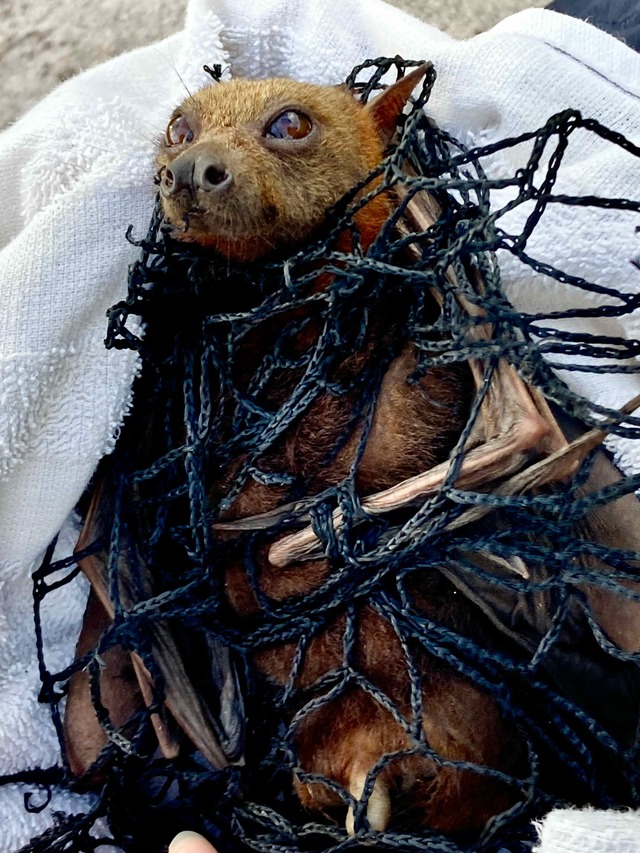
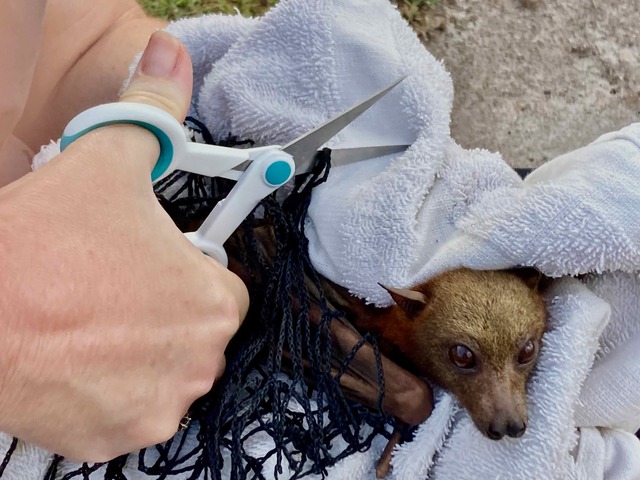
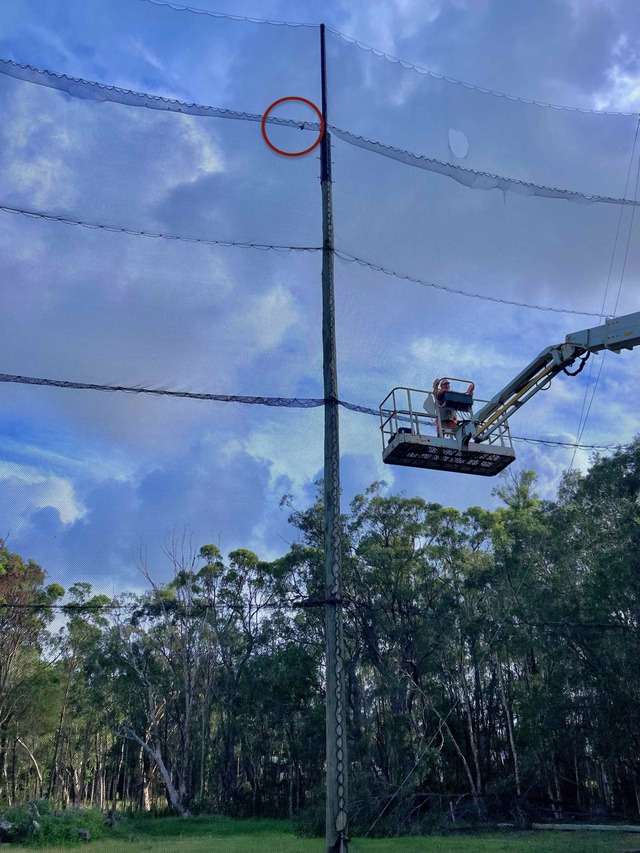
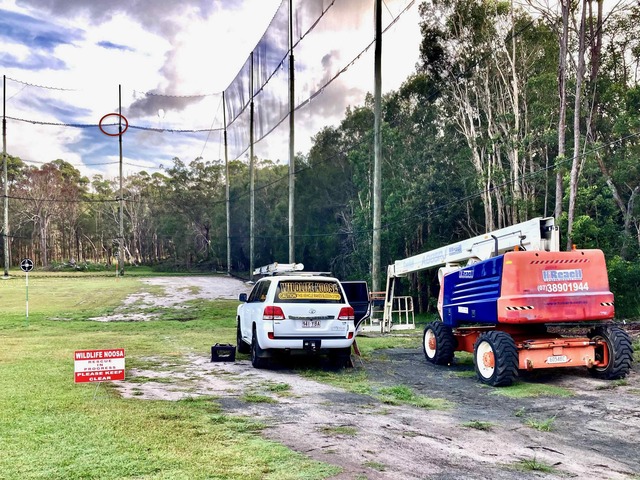
Wildlife rescuers have conducted a daily rescue mission for more than a week to save the lives of little red flying foxes that have become entangled in driving range nets at Noosa Golf Club while stakeholders came together last Thursday to find a longer term solution.
Wildlife rescuer Bernard Jean said two flying foxes were trapped on Sunday, one rescued, one managing to escape by itself, and another one entangled Monday morning rescued and delivered to Eumundi Wildlife Rehabilitation Centre by 6.30am.
Sunshine Coast wildlife carer Katrina Odgers said about 15 were lost last Wednesday, and another 25 were trapped Thursday morning.
“The nets are so high. These bats are flying into them and they are exhausted,” she said.
Ms Odgers said they were transferring the bats in a critical condition to Australia Zoo.
The situation spiked on Tuesday 27 January when more than 50 flying foxes were caught in the nets resulting in multiple wildlife rescuers attempting to untangle the surviving animals and deliver them to Australia Zoo or Eumundi RSPCA Wildlife Rehabilitation Centre, but unfortunately many of them died.
Noosa Golf Club, which alerted wildlife rescuers to the trapped flying foxes, paid almost $2,000 a day for a cherry picker to assist wildlife carers to retrieve the bats.
Terrie Ridgeway of Bat Rescue Inc, who had taken an entangled flying fox into care a week prior to the mass entanglement, alerted both RSPCA and the Department of Environment Tourism Science and Innovation (DETSI) to the situation.
Last Thursday flying fox specialists, Noosa Golf Club representatives and Gabba Sporting Nets met, arriving at immediate and long-term measures to address the problem and improve wildlife safety.
Wildlife South East Queensland (SEQ) president Antony Born said they were satisfied with the response from the golf club.
“They’ll be putting up wildlife-friendly nets with reflectors and lights. We’re grateful everyone has come together to try and solve this issue.”
Mr Bourn said the agreement marked a positive step forward after what he described as a confronting and largely preventable tragedy, highlighting the risks posed by large-scale netting in known flying fox flight paths.
Noosa Golf Club president Dale Officer told Noosa Today the club had begun implementing interim measures, including additional lighting installed to make the netting more visible to flying foxes as they travel at dusk and during night feeding movements.
He said the club planned to remove and replace the top two decks of the existing netting over the next two weeks, reconstructing them using wildlife-friendly materials, reflectors and improved lighting systems designed to reduce the risk of further entanglements.
Ms Ridgeway said the little red flying foxes were Australia’s most important pollinators and seed dispersers and vital to the health and regeneration of native forests due to their transportation of pollen and seeds over large distances.
She described their capture in the nets as a horrible situation in which the animals could have suffered dehydration, heat stroke, broken bones, concussions.
Little Red Flying-foxes are regular visitors to Noosa as they seasonally migrate to Southeast Queensland coinciding with the annual blossoming of bloodwoods and other eucalypt species.
Flying-foxes are protected under the Queensland Nature Conservation Act 1992 and the Commonwealth Environment Protection and Biodiversity Conservation Act 1999 (EPBC Act).
Authorities and wildlife organisations will continue monitoring the site as the upgrades are rolled out, with further updates expected in the coming weeks.
Members of the public can report wildlife incidents on 1300 130 372.