Every Tuesday morning during school term, something quite special happens in Tewantin.
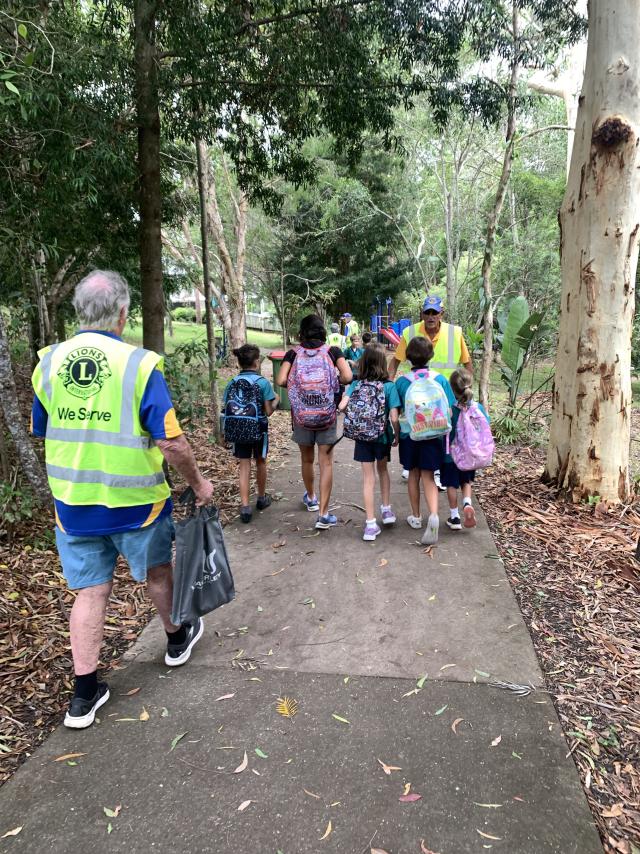
For more than four years, the Tewantin–Noosa Lions Club has been running its Walk to School program, a local version of a Walking School Bus that brings children, parents and volunteers together for a healthy start to the day.
Around 8 am, parents begin arriving at Crank Creek Park on Outlook Drive, dropping off children eager to join the walk. Up to 20 students regularly take part, greeting Lions volunteers with smiles, chatter and plenty of enthusiasm. At about 8.10 am, the group heads out along Tewantin’s safe pathways, arriving at Noosaville State School roughly 20 minutes later.
The volunteers have built strong relationships with the children over the years, sharing laughs, high-fives and stories along the way. On the first walk back this year, the excitement was palpable, with children bubbling over with holiday tales as they set off.
“Today they were talking about their Christmas presents,” says Michael, one of the regular Lions volunteers. “One boy was saying he’d been shopping and bought a shark, another was talking about a dinosaur, and the girls were singing. It’s delightful — it really is.”
The walk covers just under two kilometres, and each child is rewarded with a voucher for an icy pole — a small but much-loved incentive provided through the Council’s Go Noosa program.
Beyond the fun, the benefits are significant. Regular walking helps children meet daily physical activity recommendations, improves mood and alertness, and supports long-term health and wellbeing into their teenage years and adulthood.
Colin, another long-term Lions volunteer, explains that the program is just as rewarding for the adults involved. “What we get out of it is the chance to communicate with young people,” he says. “We also get the exercise ourselves. When you walk with younger people, you feel younger.”
Michael agrees, noting the impact once the children arrive at school. “Because the kids get to school and they’ve already had some exercise, they’re ready for class — and that’s a real positive.”
Programs like Walking School Buses also play an important role in changing transport culture. In the 1970s, more than 70 per cent of children walked to school. Today, that figure has reversed, with over 70 per cent driven instead.
Encouraging walking reduces traffic congestion around schools, lowers emissions, and improves safety in school zones. Just as importantly, group walking builds connections — children and adults get to know neighbours, strengthening community ties.
Walking School Buses are a simple but powerful idea: children walk together along set routes, accompanied by adults. Popularised in Australia in the 1990s, they now form part of active travel strategies across many Queensland communities.
Volunteer Louise, who has been a Lion for 15 years, says the experience has been deeply rewarding. “Being a Lion has given me a great outlook on the community,” she says. “The walking bus is easy for me — I live nearby — and I love interacting with the children and seeing their enjoyment as they burn off some energy before school. I’ve also been involved in school breakfasts at Tewantin State School for 15 years. It’s incredibly satisfying to give back.”
To find out how to volunteer or to get your child involved contact the Tewantin-Noosa Lions Club at tewantinnoosa.qld@lions.org.au