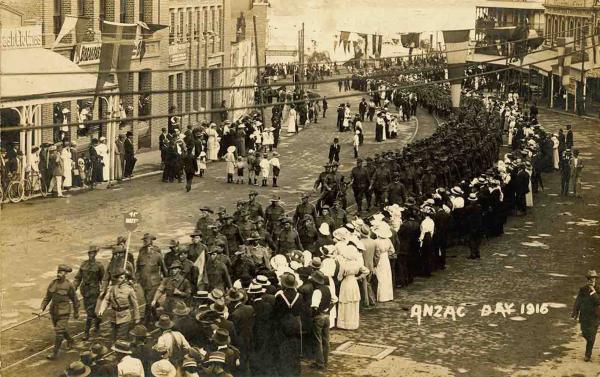
Although the very first commemoration of Anzac Day was held on the first anniversary of Gallipoli in 1916, this Anzac Day marks the centenary of the establishment of a working party to raise funds for permanent memorials in Noosa Shire.
In 1921, the tiny townships of Tewantin and Cooroy raised enough to build Anzac memorials in time for an unveiling on Anzac Day 1922. Tewantin’s life-sized sculpture of a Light Horseman has been moved from its original home in Memorial Park and partially rebuilt over the years, but it remains the centrepiece of the town’s Anzac commemoration.
What is little-known, however, is the fact that the heroic Gallipoli landings and the tragic loss of life in the defeat by Turkish forces were mirrored in a local story that in many ways exemplifies the Anzac spirit.
In 1914, just before the outbreak of World War I, Nahum “Ted” Massoud, a Lebanese immigrant and father of four who had only been in town for a few years, shocked the riverside community by paying cash for the Riverlight, one of the best working boats on the river. It wouldn’t be the last time that Massoud or one of his large clan would shock Noosa with the audacity of their plans, nor their penchant for hard work, but if the locals had known a little of Ted Massoud’s story, they would not have been surprised at all.
At the turn of the century, in the Lebanese town of Raas-Baalbek, young Nahum fell in love with a girl called Etore, whose parents advised her to flee the hardships and violence of the Ottoman Empire and make a new life in faraway Australia. Nahum’s parents agreed and provided a willing uncle to chaperone the young couple on the long sea voyage. Within days of their arrival in Melbourne, they were married in St Patrick’s Cathedral, and soon after sailed for Bundaberg with two quid to tide them over until Nahum could find work in the only trade he knew — hawking. Since neither of them spoke English at this point, selling door to door and in public squares gave them the chance to pick up words and phrases.
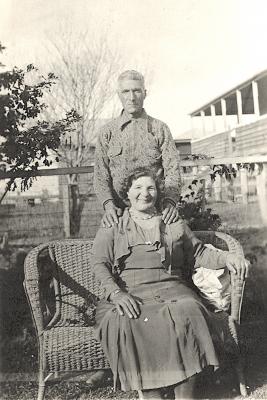
By the time they reached the Gympie goldfields in 1906, they had basic communication skills, had anglicised into “Ted” and “Edith”, and had started a family. On the goldfields, Ted formed a friendship with another miner, Ned Ely, whose father Bill had followed the path of several Gympie miners who had made good, and resettled the family on the banks of the Noosa River. Ned painted such an appealing picture of this Arcadian river that met the sea in a plentiful fish-ground with a backdrop of rolling green hills, as they walked back to town after a day’s work, that Ted was soon sold. Soon after third child Maisie’s birth, the growing Massoud family moved to Gympie Terrace, making a down payment on one of Bill Ely’s leases, on the corner of the lane that would become Edward Street. Here, over the years to come, the patriarch and matriarch would become better known to their small community as “Jiddy” and “Sitty” — Arabic for grandpa and grandma.
With several mouths to feed, Jiddy and Sitty began fishing, and generally caught enough to sell a few fillets in their general store on the riverfront. At first they caught bream at night on lines, then progressed to nets to haul in large mullet catches. After Jiddy bought the Riverlight in 1914, the family had to hire staff to help out with their fast-growing river enterprises.
In business and in community affairs on the Noosa River, the Massouds were only just getting started when the Archduke Franz Ferdinand of Austria-Hungary was assassinated in Sarajevo in June 1914, setting off events that would culminate in World War I. In the coming years, the Massoud homeland of Lebanon, nominally allied with Germany as part of the Ottoman Empire, would be caught in the Middle Eastern crossfire and see half its population starved to death as supply lines were cut off.
We don’t know how much of an impact this had on the stolid Jiddy and Sitty, even when Australia entered the war as a member of the British Empire, and local boys began enlisting for the “grand adventure” that would see so many slaughtered on the beaches of Gallipoli and on the Western Front. Since their culture had been subsumed by the Ottomans, many Lebanese in Australia (known until the 1940s as Syrians) had little or no political affinity with their homeland, yet they were technically the enemy. Even while Jiddy and Sitty raised funds for the Noosa Shire Patriotic Appeal, hundreds of equally patriotic migrants were being herded into a hastily built internment camp next to the Enoggera Army Barracks in Brisbane.
Lebanese–Australian historian Dr Anne Monsour, whose grandparents came from the same village as Jiddy and Sitty, and who is related by marriage to the Noosa clan, writes of the situation: “For Lebanese families in Australia, the First World War exacerbated their experience as outsiders and reminded them their acceptance was tenuous … In October 1914, the Commonwealth Parliament passed the War Precautions Act. As Turkish subjects, Lebanese were declared enemy aliens and placed under surveillance.”
Many Lebanese were interned for the duration of the war, but to the eternal credit of the new Noosa Shire, the hard-working, community-minded Massouds were among the new settlers who were protected from the authorities.
Noosa was not slow to answer the call to duty. By February 1916, the shire chairman was able to report that more than 200 men from the shire population of 2,000 had volunteered for the front, with many casualties and several deaths (by the end of the war, it would be 350 injured with 40 dead). On the home front, more than £3,000 had been raised for the Patriotic Fund, a thousand of it on one day, with Jiddy Massoud and older sons George and Bill prominent among the fundraisers.
Then finally, in November 1918, peace. When news of the Armistice came down the wire, a
week-long celebration began in Noosa Shire, culminating in a torchlight Saturday night procession through the streets of Tewantin to the green beside the 400-year-old fig tree, which had been a meeting place for the Kabi Kabi for several hundred years before the arrival of the Europeans.
The civic fathers and business leaders gave thanks for the end of hostilities and paid homage to those who had made the supreme sacrifice. Last but one to speak was Ted “Jiddy” Massoud, who stood proudly in the warm night air with his work shirt buttoned to the neck and his hair neatly slicked down, and, representing his extended clan and the fishing fleet of Noosa, gave thanks for the tireless work of the entire community — his and Sitty’s community.
Rejoining the throng, he slipped his hand into Sitty’s as they all sang “Our Brave Aussie Boys”, “La Marseillaise” and “God Save The King”.
More than a century on, the Massouds remain an important and ongoing part of Noosa’s history.
This article is adapted from Phil Jarratt’s forthcoming Noosa history, Place Of Shadows, to be published by the Boolarong Press in July.