
It’s certainly feeling like summer now, with warm days and stormy afternoons. This means it’s also prime breeding season for cane toads. Cane toads are toxic at every life stage – from eggs all the way through to adulthood.
You’re probably well familiar with what a cane toad looks like, but can you identify cane toad tadpoles and eggs?
Removing cane toads at every life stage – before they grow up to cause damage to native wildlife and pets – is key to controlling these pests.
Here are some key features you can use to identify cane toad eggs and tadpoles.
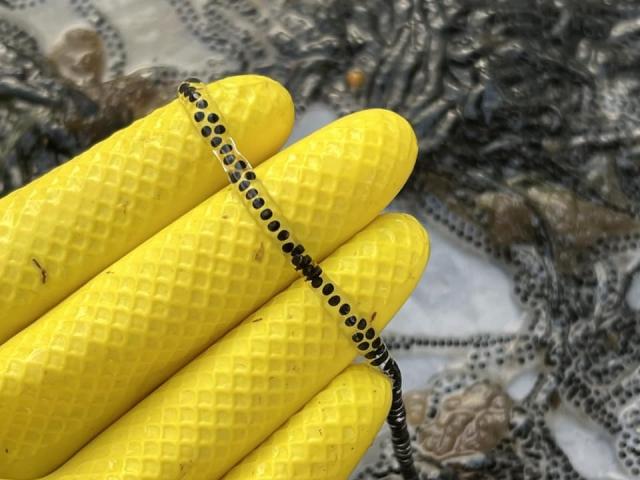
Cane toad eggs form into long jelly strings which come to rest under the water and among vegetation, whereas most frog eggs form into lumps of jelly or foam.
Female cane toads will lay between 8000 and 35,000 eggs in one clutch and may lay up to two clutches per year. The eggs are short-lived and will hatch after around three days. Native frog tadpoles will feed on cane toad eggs and are poisoned in the process, so it’s important to pull them out as soon as you see cane toad eggs.
Cane toad tadpoles can be identified by their appearance and behaviour. They will swam together in the shallows where the water is warm. They love the sun and will be seen basking in the heat of the day at the water’s edge and on rocks. There may be thousands of them in a small space.
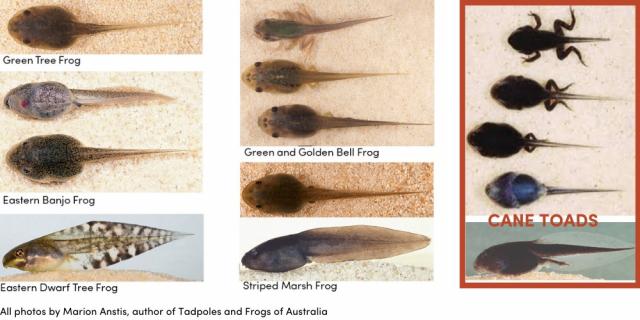
Toad tadpoles are jet black with an opaque sheen to their belly and they will grow to about 3cm in size. They have black tails surrounded by clear frill which makes their tails appear quite slim. Their eyes are placed on the top of their heads and they will already have a hint of a strong ridged brow developing which makes them quite bulky and diamond shaped in appearance. In contrast, many frog species have longer bodies.
Unlike toad tadpoles, frog tadpoles don’t swarm unless they have to.
In an ideal environment they don’t bask in the sunny shallows as cane toad tadpoles do but potter around looking for food among water plants. However, in small water-bodies, ponds, pools, puddles, they may be forced to swarm.
Frog tadpoles develop lungs earlier than cane toad tadpoles and will come up to the surface regularly to breathe.
Native frog tadpoles come in a variety of colours ranging from browns to greens and beiges and will sometimes have spots or striped patterns. They come in a variety of shapes with some appearing big and bulgey and others slim and dainty. Some of them will look similar to cane toad tadpoles like the spotted marsh frog tadpole which is a chocolate brown colour, almost black, so make sure you pay attention to small details. Catch one in a glass so you can get a better look at them for a definitive identification.
Keep an eye on your ponds, waterways and streams this summer and look for signs of cane toad breeding.
It’s far easier to remove eggs and tadpoles than it is to catch thousands of adult cane toads.
If you are ever unsure, it’s always better to leave a cane toad than remove a native frog. For more information and help on cane toad identification, visit the Watergum website at watergum.org or email canetoads@watergum.org