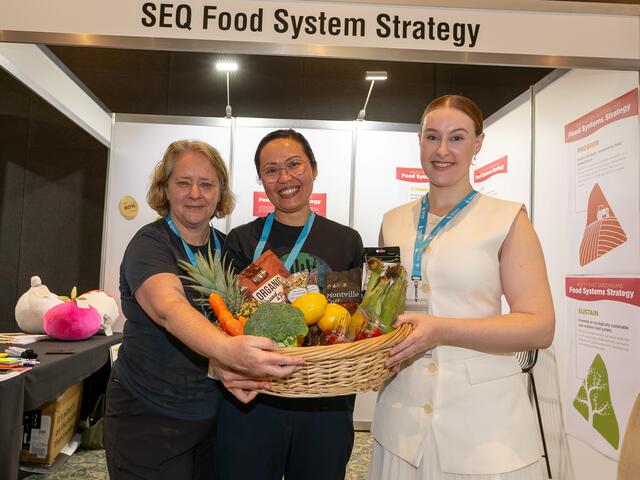
Work is underway by Australia’s national science agency CSIRO and the Council of Mayors (SEQ) to develop Australia’s first evidence-backed regional food systems strategy for South East Queensland. Workshops have been held at the Sunshine Coast and in Brisbane bringing together food system stakeholders and industry representatives to help inform the strategy.
The Strategy follows the release of the first national stocktake of Australia’s $800 billion food system in June, calling for a coordinated approach to managing complex challenges across the sector.
South East Queensland’s population is projected to reach six million by 2046, when it will be home to 75 per cent of all Queenslanders and 1 in 6 Australians. The region currently generates over $334 billion in gross regional product, contributing two-thirds of Queensland’s total economic output and 75 per cent of all Queensland jobs.
SEQ’s food sector is a significant economic and job generator with more than 11,700 agricultural businesses employing more than 28,000 people. Over 20 per cent of the State’s total agricultural production is grown in SEQ, generating more than $11.9 billion in exports annually and supporting local manufacturing, logistics and export industries.
Lockyer Valley, ‘Australia’s salad bowl’, is among the world’s most fertile farming regions. The Lockyer Valley and Somerset regions currently provide 40 per cent of Queensland’s fresh produce and 5 per cent of the nations. Toowoomba Region supplies 90 per cent of the state’s pork and 85 per cent of its eggs, highlighting the region’s critical contribution to national food security.
Feeding our growing population into the future means tackling a range of challenges including water security, climate shocks, growth pressures and global demands generated on the back of major events including the Brisbane 2032 Olympic and Paralympic Games.
The food system encompasses all interconnected components involved in producing, processing, distributing, consuming, and managing food waste.
The strategy will identify pressures, opportunities, actions and responses to help ensure SEQ’s food system is ready for 2032 and beyond. It will be developed with councils, government agencies, industry and community groups.
The project is supported by the Department of Primary Industries and will build on the Queensland Government’s Prosper 2050 blueprint to increase the State’s primary production output to $30 billion by 2030.
Council of Mayors (SEQ) Chair, Lord Mayor Adrian Schrinner said Councils can’t solve these challenges alone, so strong partnerships with other levels of government and industry are critical to make sure our food system is ready for the future.
Council of Mayors (SEQ) Leveraging 2032 Chair and Toowoomba Region Mayor, Geoff McDonald said they know the challenges facing our food system are complex, and want our local businesses to be ready to benefit from opportunities in the lead up to 2032 and beyond.
Primary Industries Minister Tony Perrett said their focus was on developing a prosperous industry and building a food system that was resilient, sustainable and ready to feed a growing Queensland well beyond 2032.
“We want to see locally grown food processed and packaged in Queensland, creating jobs all the way along the supply chain, because that’s good for local communities and for local produce,” he said.
CSIRO Project Lead, Dr Cathy Robinson said their report, the first national stocktake of Australia’s food system, showed we need to strike a better balance between the economics, sustainability and health and equity outcomes for our communities when it comes to food.
“We know across the different regions of Australia agriculture is thriving, but there are other aspects of the food system that are in urgent need of attention,” she said.
“Better management of our food system in broad regions such as South East Queensland, can lead to wide-ranging benefits such as healthier and more affordable food; stimulation of local economies, better health outcomes and improved sustainability when it comes to food waste.”
The Strategy will be complete in 2026. For more information, visit: South East Queensland Food Systems Strategy – Food System Horizons