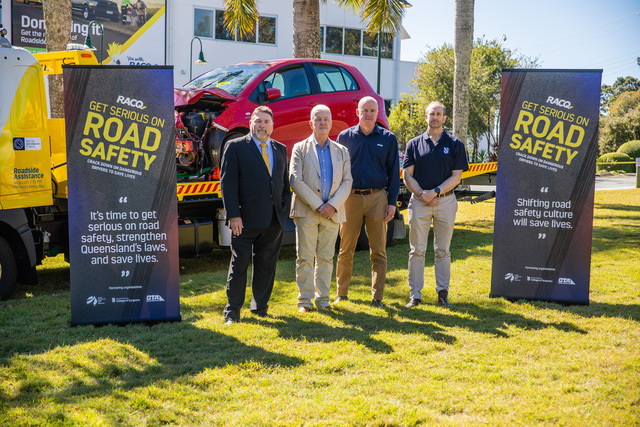
RACQ has reunited with some of the nation’s leading road safety advocates to call for urgent action in the wake of Queensland’s most devastating road toll in 16 years.
Sadly, 308 people were killed on Queensland roads in 2025, with thousands more lives changed forever. It’s a statistic that Queensland’s peak motoring body, alongside the Royal Australasian College of Surgeons (RACS), the Safer Australian Roads and Highways (SARAH) Group, and the Queensland Trucking Association (QTA), wants addressed immediately to prevent further tragedy.
RACQ Managing Director and Group CEO David Carter said the shocking number of fatalities is a clear signal that all Queenslanders must do better to tackle the road safety crisis.
“We need a strong program of behaviour change, data transparency and policy change to reverse this worsening trend in Queensland,” Mr Carter said.
“Three of the past four years have recorded road tolls around or above 300, and for the past two years, the number of people dying on our roads has climbed even higher. Thousands more are hospitalised, placing enormous strain on our health system.
“Between 2019 and 2023, there were 31,742 crashes where people were killed or seriously injured, equating to a staggering social cost of $37.5 billion.
“Governments have a role to play but can’t do this on their own. The buck stops with every road user to own their behaviour and improve road safety culture. Some groups continue to be high-risk, particularly young drivers, male drivers and motorcycle riders.
“We need every driver to take responsibility for their decisions on the road, but we also need to better understand what is behind this crisis, so data must play a key role in finding meaningful solutions.”
RACQ and its partners are urging the Queensland Government to join other states by releasing and utilising comprehensive fatal and serious injury crash data to guide evidence-based decisions and target high-risk areas with investment in infrastructure and enforcement.
Another key part of the cultural shift is ensuring motorists understand that when they are on the road, there is an increased chance they will be caught. This is something RACQ has advocated for through its Get Serious on Road Safety campaign, and we commend the Government for committing to having an increased on‐road police presence from 2026.
RACQ’s latest survey reinforces this, with 83 per cent of members supporting a greater police presence on our roads and recognising the powerful deterrent effect of flashing blue and red lights on dangerous driving.
Alongside an increased police presence, RACQ and its partners have been calling for further action, including:
• A continued increase in random alcohol and drug testing to remove impaired drivers from our roads
• Expanded program increasing the number of new point-to-point speed cameras to 5 per year to slow
down drivers over longer distances
• Expanded vehicle impoundment laws to remove repeat and extreme offenders from their vehicles and
reduce unlicensed driving
• Motorcycle licensing reform to ensure riders have the skills to ride for life
Other measures should include improved drug rehabilitation services, mandatory drug and alcohol tests at crash scenes, peer-to-peer road safety initiatives and supporting a Vehicle Security Standard rating system to combat vehicle theft.
“RACQ stands ready to work with all levels of government on solutions to stop this crisis on our roads and save lives,” Mr Carter said.
Professor Martin Wullschleger from the Royal Australasian College of Surgeons echoed the call for change, highlighting the devastating consequences of road trauma.
“Our surgeons witness the consequences every day. The people we treat are often the survivors, many of whom go on to live with debilitating and lifelong injuries, unable to walk, talk, eat or function without care,” he said.
“Prevention is the only cure and that means stronger enforcement and smarter policy.”
SARAH Group Founder and President Peter Frazer OAM understands this tragedy all too well, having lost his daughter in a crash that should never have happened.
“Everyone has a right to get home safe to their loved ones every day and yet 308 lives were lost in Queensland. With so many innocent lives lost, this is not only heart breaking but both a state and national disgrace,” Mr Frazer said.
“Something must give. It’s time for stronger enforcement and consequences to stop this unnecessary and tragic loss of life.”
Regional Queensland remains one of the hardest hit areas, according to RACQ’s crash dashboard – a trend QTA CEO Gary Mahon says is all too familiar.
“Many people are unprepared to drive on our regional roads. We strongly urge all motorists to prepare their trips like professional truck drivers – prepare your vehicle, assess your fitness to drive, plan your route, schedule breaks, and be emergency ready.
“The QTA strongly supports the call by the RACQ to take serious action to prevent more loss of life on our roads, including having a stronger focus on repeat offenders and how they are dealt with in the courts.”
“Queenslanders have a choice to drive safely. Make that choice. Be more patient and make a conscious decision to arrive alive.”
For more information visit RACQ’s Get Serious on Road Safety website.