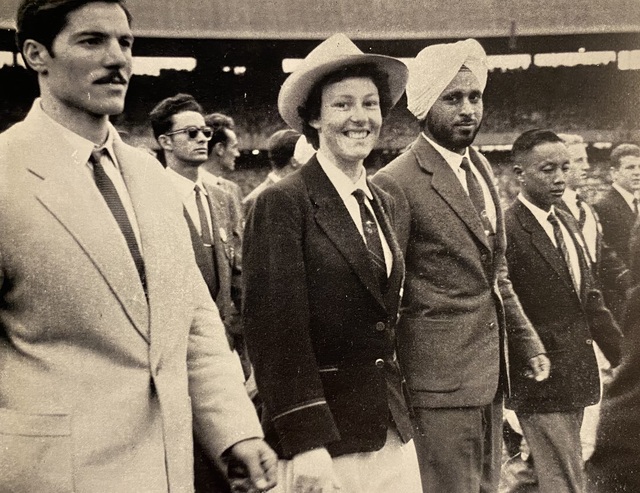
The 1956 Olympic Games in Melbourne are often described as ‘The Friendly Games’.
Swimming legend Dawn Fraser and fellow Olympians from the Sunshine Coast, who will be among those celebrating the 70th anniversary of the Games at the Sunshine Beach Surf Club next Thursday, were fortunate, however, that several difficulties and controversies affecting the Games were overcome.
In spite of being the first Olympic Games in the Southern Hemisphere, the Melbourne Organising Committee (MOC) had expected a record number of nations. However, several countries threatened boycotts.
Just 24 days before the Opening Ceremony on November 22, war broke out between Egypt and Israel over the Suez Canal on 29 October. When Britain and France joined in, Egypt withdrew.
Then on 4 November, Soviet troops launched an attack on Budapest and several nations boycotted to protest at the actions of the USSR. The Netherlands Olympic Committee sent a gift of 100,000 guilders – the amount of money saved by not competing in Melbourne – to aid victims in war-torn Hungary. Dutch athletes, already in Melbourne, were recaIled.
Spain also withdrew because of the Hungarian crisis; the Sydney Morning Herald of 8 November, suggesting Spaniards would not wish to fraternise in Melbourne with participants from communist nations.
The Swiss Olympic Committee decided to send a team only if there was agreement among the seven participating Swiss national sports federations; there wasn’t.
Chancellor of the IOC and Swiss citizen Otto Mayer was appalled at the decision, stating “it is a disgrace that Switzerland, a neutral nation and the very country where the IOC has its headquarters should set such a shameful example of political interference with the Olympic ideal”.
The Swiss Olympic Committee changed its mind but, unfortunately, its indecisiveness meant there was not enough time for the entire team to travel to Melbourne, so it withdrew.
As late as 13 November, and in spite of collectively having more than 200 athletes already in Australia, five Scandinavian countries (Denmark, Finland, Iceland, Norway and Sweden) had not made a firm decision to compete. The Scandinavian Federation, however, met in Melbourne and decided that all five countries would participate.
These world tensions disrupted final preparations for the Games in several ways.
The traditional Torch Relay bearing the Olympic Flame from the altis at Olympia, Greece, was delayed a day because the conflict in the Suez Canal had affected flight schedules at Athens airport. Fortunately, time was made up along the route.
P & 0 passenger liners from Europe to Melbourne could not use the canal and were forced to sail around the Cape of Good Hope. The ‘Hungarian Revolution’ caused its Olympic team and officials to arrive in Australia one week later than scheduled.
Both the PeopIe’s Republic of China and the island nation of Taiwan (Formosa) had been recognised by the IOC in 1954.
Otto Mayer wrote in a letter (28 October, 1956) to Chairman of the MOC Sir Wilfred Kent Hughes. “We have received a protest from Peking China against the participation of Fonnose [sic] China in the Games. Mind that the two Chinese teams are not too near each other in the Olympic Village”.
But tension between these two Chinas was so great that mainland China withdrew.
Throughout these conflicts Australian Olympic officials implored nations and athletes to come to Melbourne to ensure the real spirit of the Olympic Games would triumph. Internationally, Mayer and IOC President Brundage also asked athletes and governments to keep politics out of the Games and not deny the “Olympic Movement fulfilling its humanitarian role in the interests of world peace and international goodwill”.
Withdrawals by nations in October and early November caused some organisational problems. Ultimately, Melbourne hosted 67 nations with 2813 male and 371 female competitors – a total of 3184 athletes.
The USA and the USSR emerged from the Second World War as dueling super-powers and, for many, the supremacy of their ideologies would be tested on the international sporting arenas.
Although there is much more known now about the ‘Cold War’, those present at the Olympic Games in Melbourne seemed to embody the spirit of an ‘Olympic Truce’, especially in relation to the athletes from the USSR. It was clear from the cheering and encouragement of the huge crowds in the Main Stadium that the efforts of Vladmir Kuts and the many successful Soviet women athletes in the field events were appreciated.
The magnificence of the male and female gymnasts from Russia, who won eight individual and two team gold medals, also enthralled the many spectators at the West Melbourne Stadium.
There was an infamous incident in the semi-final of the Men’s Water Polo match between Hungary and the USSR.
The Hungarians were leading 4-0 when two USSR players taunted them by repeatedly calling them ‘fascists’.
At one stage the referee had ordered five players out of the water for punching, kicking and scratching; although clearly an exaggeration, a journalist reported a Russian player punched a Hungarian player in the eye when not near the ball. The Swedish referee abandoned the match, declaring Hungary the winners.
The crowd was incensed at the behaviour of the Soviet team and only the appearance of police, who had been waiting out of sight, prevented a riot.
On the other hand, not even the notorious 10-foot high barbed-wire fence separating the men’s and women’s residences in the segregated Olympic Village in Heidelberg could prevent the blossoming romance of a Czechoslovakian and an American. Discus thrower Olga Fikotova and Hammer-thrower Harold Connolly, gold medallists in their respective events, later married in Prague.
In the mid-1950s the IOC began to recognise the financial opportunities that might flow from the sale of television rights. In December 1955, the MOC received tenders from four overseas companies for exclusive newsreel and television rights.
By April 1956, however, none of the television companies were prepared to pay for television rights to cover the Games because of a conflict over the distinction of what constituted a ‘news item’ and an ‘entertainment package’. During a meeting in New York in July, Australian team manager Kent Hughes offered newsreel companies coverage of three minutes per day, more than what had been used at the 1952 Helsinki 0lympics.
American television newsreel interests, however, requested three minutes for each of the three news sessions – a total of nine minutes. The MOC decided that “no television entertainment departments and no film entrepreneurs would be interested in Olympic coverage if “more than the three minutes per day were granted to the newsreels”. Subsequently, newsreel companies and international television networks boycotted the Melbourne Olympics.
The MOC decided on the production of a 16mm colour plus a black and white film, thereby satisfying the requirements of the IOC. A French film unit also undertook to make a feature-length wide-screen colour film.
Television transmission in Australia from stations in Melbourne in Sydney started only weeks before the start of the Games. Agreements had been made for local stations to televise from any site where seating had been fully sold. Since the Main Stadium (MCG) and many other venues fitted this category, television companies were given the rights to televise daily.
The charge for this live coverage, the first for a host nation, was a ‘nominal payment’ to the MOC because there were only 5000 television sets in operation throughout Australia!
It is believed the Games were the first to have full television coverage to the host community, albeit to a small local audience. In a unique arrangement, GTV9 (now Channel 9) and Ampol Petroleum joined forces to turn Ampol petrol stations into ‘television theatres’ for people who did not have television sets in their homes.
Community homes were also utilised with the Age newspaper reported on its October 19 front page that charity organisations had contacted GTV9 and Ampol for permission to charge admission fees.
More than 20 hours of coverage per day for 10 of the 15 days of the Games were provided to viewers in the State of Victoria by the three television stations (GTV9, HSV7 and ABV2). Sydney and parts of New South Wales received television coverage when the 16 mm films of the day’s events were flown to Sydney each night.
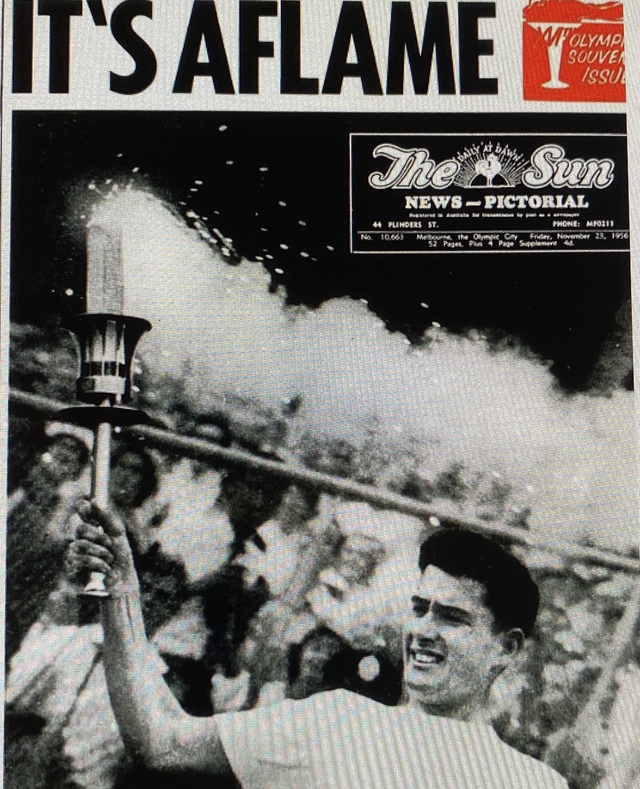
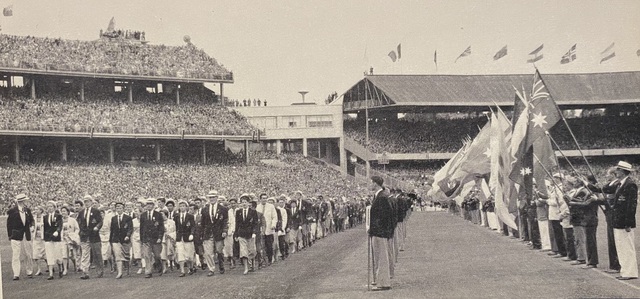
On 22 November athletes from Greece entered the stadium for the Opening Ceremony to the cheers of over 100,000 spectators. Many weeks earlier, the Olympic Flame landed on the host nation’s soil in Darwin and given to the first relay runner – an Australian-born Greek, who carried it to the second – an Australian Aboriginal. The last of 3500 Torch bearers was Australian junior-mile record holder Ron Clarke.
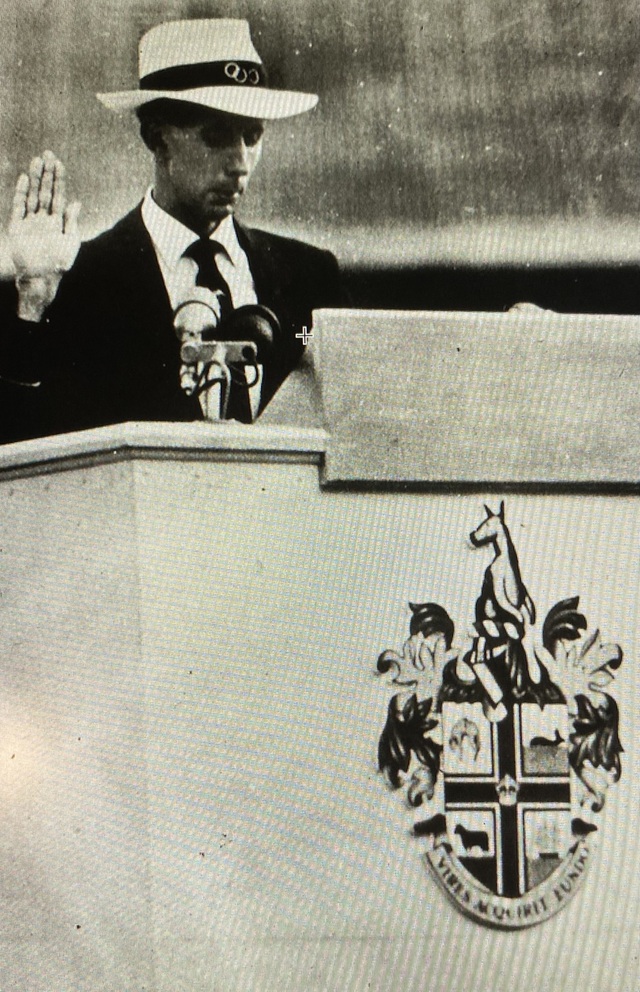
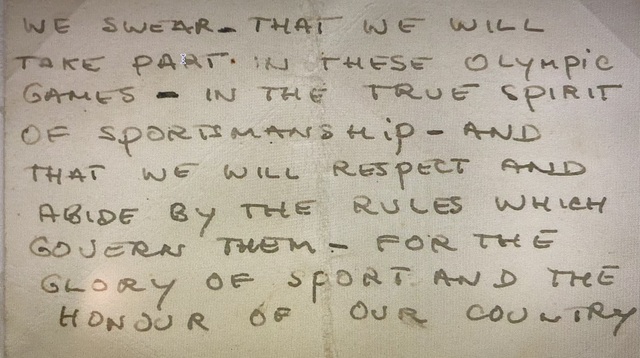
When John Landy, the great sub four-minute miler and then world-record holder for that distance, pronounced the Olympic Oath, his version was different from the one printed in the programs. Landy was advised that the text, in bold print, would be on the lectern. It wasn’t. Fortunately, he had written a rough copy out on a small card which he pulled from his pocket.
Overall, 36 Olympic and 11 world records were broken in track and fField events which were dominated by the USA: Bobby Morrow, wearing ‘bobbysocks’, became a triple gold-medalist by winning the sprint double and anchoring the 4 x 100m Relay. [I was there and saw Queenslander Hector Hogan win the bronze medal in the 100 metres.]
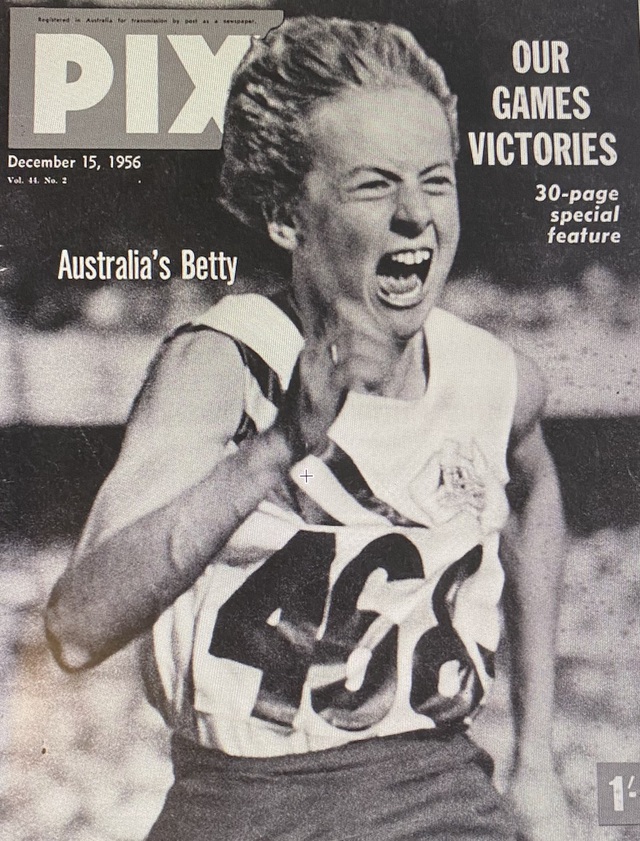
Australian athletes won a total of 13 gold medals – their best-ever performance. Australia’s ‘Golden Girl’ on the track was Betty Cuthbert, who won three gold medals. The Australian female track team won every event. There were only four -100m, 200m, 80m Hurdles, and 4 x 100m Relay.
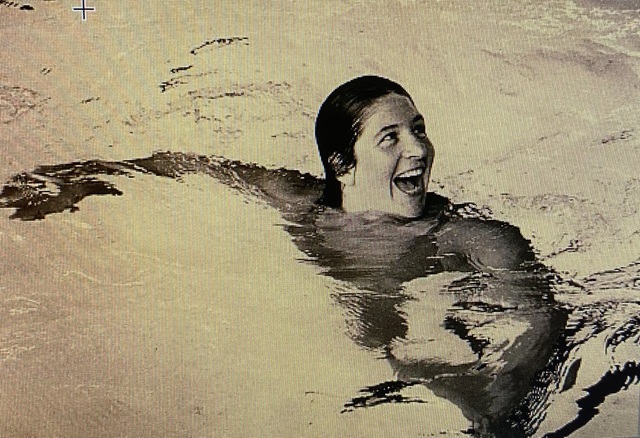
Dawn Fraser, making her Olympic debut, and other Australians ‘scooped the pool’; Dawn won two gold and a silver. Murray Rose won three and Jon Henricks two gold medals, respectively.
Brian Harper, now Australia’s second-oldest Olympian, and who will be attending the 70th Anniversary function at the surf club was seventh and ninth in the 1000m and 10,000m canoe singles, respectively.
A feature of the Closing Ceremony has become a symbol of the Olympic philosophy of interactionalism and goodwill. At the Opening Ceremony and throughout the Games, athletes, were identified by nation.
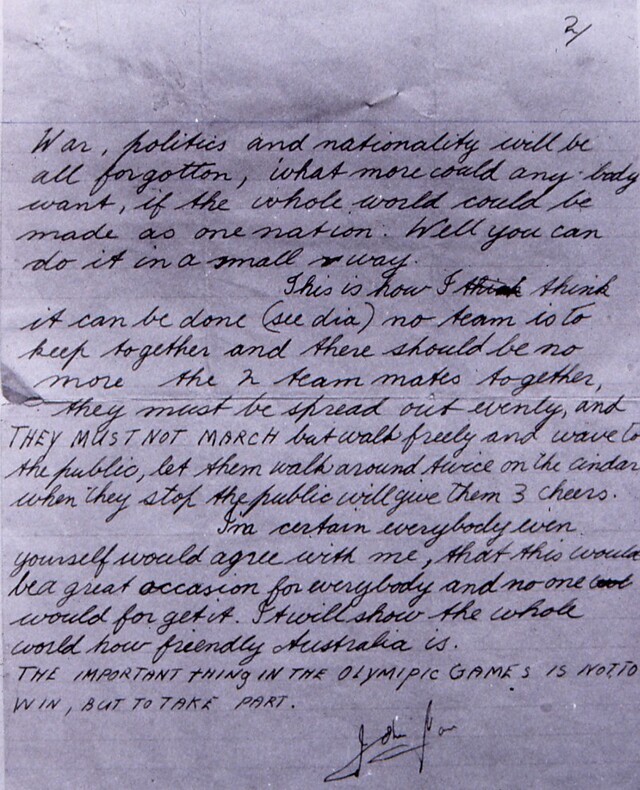
The idea of a different Closing Ceremony for Melbourne was outlined in a letter to the chairman of the MOC Kent Hughes written by a 17-year-old Chinese Australian, John Ian Wing.
In the final week of the Games, Wing wrote:
“The march I have in mind is different than the one during the Opening Ceremony and will make these games even greater, during the march there will only be 1 NATION. War, politics and nationality will be all forgotten, what more could anybody want, if the whole world could be made as one nation. Well, you can do it in a small way. … no team is to keep together and there should be no more than two team mates together, they must be spread out evenly, THEY MUST NOT MARCH but walk freely and wave to the public, let them walk around twice on the cinder, when they stop the public will give them three cheers […]. It will show the whole world how friendly Australia is.”
[The three-page hand-written letter, owned by the National Library of Australia, is displayed in the National Museum of Sport at the Melbourne Olympic Stadium (the MCG)].
Arrangements for Wing’s modifications were only endorsed by the MOC and the IOC on the day before the Closing Ceremony. A description is featured in The Official Report of the 1956 Games [p.26]:
“Then the climax, with its stunning impact on the imagination of the people, a prophetic image of a new future for mankind – the athletes of the world not now sharply divided, nation by nation, but in this Closing Ceremony of comradeship, marching as one in a hotchpotch of sheer humanity, … It was a chaos of friends impacted into a mass, a fiesta of friendship, goodbye and goodwill.”
Wing’s vision of Olympism has become a tradition of the Closing Ceremony of the Olympic Games.
For many Australians, as well as visitors, the first Olympic Games in the Southern Hemisphere, were an opportunity to really comprehend the saying, ‘It’s not the winning but the taking part“. In spite of strained relationships between the organisers and the IOC, as well as political tensions throughout the world in the months leading up to the Olympics, they truly deserve to have become known as the ‘Friendly Games’.
The 70th Anniversary Celebration is open to all sports lovers and will take place in the Sunshine Beach Surf Club’s Ocean View Room from 4pm to 7 pm on Thursday 12 March.
Olympic boxer at the 1980 Moscow Games, and member of the Sunshine Coast Region 2032 Olympics Legacy Taskforce member Benny Pike has arranged for 1956 Melbourne Olympians Dawn Fraser, Brian Harper (canoeing), and Warren Moore (gymnastics to be present, along with other Sunshine Coast Olympians who developed the Olympic Legacy in more recent Olympiads.
[Dr Ian Jobling is founding director of the University of Queensland Centre of Olympic Studies, and now Honorary Patron of the Queensland Centre of Olympic and Paralympic Studies. He attended the 1956 Games when a schoolboy]