
Doctor Ken Wishaw is a hero of many forms.
As a doctor, anaesthetist, Australia’s first full-time helicopter rescue doctor, medevac officer for the Royal Australian Air Force and Australian Army, Dr Wishaw’s medical career helped save lives on the Sunshine Coast, interstate and across the world.
Now in retirement, he works to defend our dark night skies.
Dr Wishaw co-founded CareFlight and the NSW Medical Retrieval Service, pioneered helicopter medicine and helped to develop life-saving initiatives and techniques like battle trauma management and a “mobile intensive care unit” for transferring patients.
In his retirement, he turned to fulfilling a lifelong passion, completing a post-graduate certificate in astronomy and becoming an advocate for the night sky.
It was something of a homecoming for Dr Wishaw.
“Astronomy’s been in my family since the mid-1800s,” he said.
“One of my first memories is my uncle showing me Saturn through the big old brass family telescope.”
He couldn’t believe what he saw.
“I asked him: is that painted on the eyepiece?”
It’s a memory that resurfaces whenever others react to the view down a telescope with the same incredulous wonder, as Dr Wishaw shares his passion for astronomy and dark skies with the community.
Dr Wishaw serves as secretary of the Brisbane Astronomical Society and co-founded the Australasian Dark Sky Alliance, which advises policy makers on light pollution matters.
He is also a leading community champion in the bid to establish a Dark Sky Reserve in the Sunshine Coast hinterland.
Establishing the proposed reserve is a project in progress by Sunshine Coast Council, with further investigations underway after a community consultation phase earlier this year.
Dr Wishaw’s dedication has now been acknowledged after he received the Dark Sky Defender Award for 2024 from Dark Sky International.
The award was one of only six handed down globally amongst its 193,000 members at the Dark Sky International Conference to committed individuals or organisations who work towards preserving night skies.
Dr Wishaw is an example of the ways everyday people are working toward a sustainable future in our Sunshine Coast Biosphere.
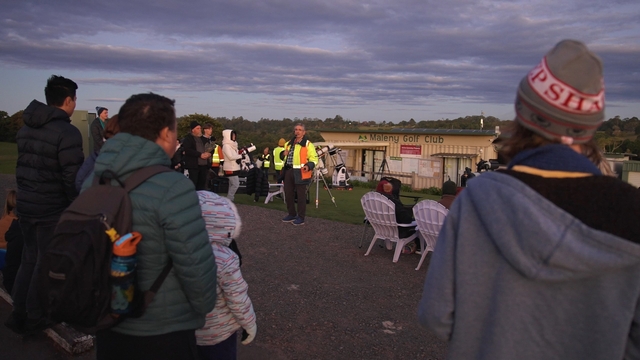
Dr Wishaw organises the popular community stargazing nights at Maleny Observatory, although cloudy conditions for much of 2024 have been a frustration.
The Sunshine Coast resident believes too many take our starry skies for granted: something he realised on a rafting trip down the Grand Canyon in the USA, travelling with others from Florida.
“The first night, they asked if I could point out the stars to them,” Dr Wishaw said.
“While I was doing this, one of them started crying.
When I asked what was going on, she said this was only the second night in her life she’d ever seen a star.”
More than 80 per cent of the world’s population lives under light polluted skies, and 90 per cent for those living in the USA or Europe.
“Environmentally, it’s important we protect our wildlife, many of which rely on the night in their predator-prey relationships,” Dr Wishaw said.
“Further, one third of plant pollination occurs at night and is seriously affected by excessive lighting.”
That’s because night pollinators such as bats and insects need dark nights to travel and feed.
Excessive light at night impacts human health and wellbeing, also contributing to more greenhouse gas emissions and higher energy demand.
“From a heritage point of view, we should remember that we’re looking up at the same stars that navigators have used for thousands of years,” Dr Wishaw said.
“Particularly our First Nations people, who were the first astronomers and the first navigators to use the night sky throughout their ways of navigating across the country.”
A Dark Sky Reserve is an international designation that recognises places across the world that are committed to preserving and protecting dark sites.
Establishing the proposed 873 square kilometre reserve would improve wellbeing, protect wildlife, support astrotourism, support responsible lighting and bring our communities together in celebration of our night sky.
The proposed dark sky reserve area includes the townships of Maleny, Mapleton, Montville, Witta, Flaxton and Conondale.
Even the process to establish the reserve presents opportunities for our community to get involved and consider their own lighting to care for our dark skies.
“Once you lose it, it’s very hard to get back,” Dr Wishaw said.
“I’d like people to look after it by doing the four simple things: not shining light up into the sky, using only warm coloured light outside, turn it off when it’s not needed or use motion sensors or timers, and spread the word to your neighbours so that they can join and do the same things.”
In ideal conditions in dark places in our region, the Milky Way can be so bright it can cast a shadow.
For Dr Wishaw, stargazing is both comforting and awe-inspiring.
“It’s a place that I’m very familiar with, so it feels like home, like my own backyard.
“When I think about the scale of it and the size of it, it’s really kind of the ultimate wilderness experience.
“You just can’t get further away and further out in the wilderness than out amongst the stars.”
Long after his first view of Saturn, it’s that same sense of childhood wonder that keeps him looking skyward.
“We live in the spiral Milky Way galaxy, which has between one and four thousand million stars and at least as many planets.
“But on any night, you can go out, hold your thumb up to the sky and know there are ten million galaxies behind your thumb.”