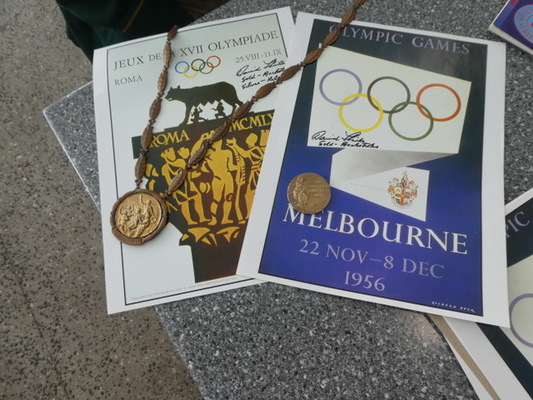
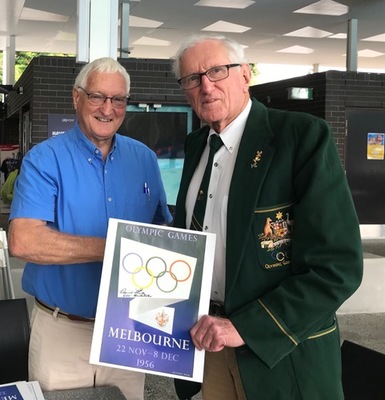
It was a ticket to the track and field event in the Melbourne Olympics in 1956 where he watched in awe as US sprinter Bob Morrow won gold and Australia’s Hec Hogan, bronze in the 100m final that set Dr Ian Jobling on his path as a Sports and Olympic Historian.
The Olympics then hadn’t achieved the prominence in society as it does today. It wasn’t held in school holidays so as a 14 or 15 year old schoolboy Ian sat an exam at school in Geelong before his dad picked him up and took him to the Melbourne highway where he flagged down a motorist to give his son a lift to the Games.
“It changed my life,” he said.
Until then he had been an unmotivated student, gaining only 17% in Latin unlike his sisters who scored 99% and 95% but he returned to school determined to become a physical education teacher.
Ian received his Physical Education Diploma from Melbourne University then went on to further study in Canada, obtaining a Masters Degree then a PhD in Physical Education in 1970, a qualification not then available in Australia.
An Associate Professor in the School of Human Movement Studies at the University of Queensland for 27 years until his retirement in 2005, Ian is director of the Centre for Olympic Studies at UQ, is founding member of the Australian Society for Sports History and is a board member of the International Society of Olympic Historians. He is the recipient of numerous awards including the 2000 Australian Sports Medal for services to the Olympic Movement and Olympic Education.
Ian combined his interests in research and education to work on the international steering committee of the Foundation of Olympic and Sport Education (FOSE) to produce an Olympic education program with the IOC and UNESCO for use in schools globally.
And he has contributed to creating sports history by recording interviews of about 40 Olympians as part of a project funded by the Australian Sports Commission and the National Library in Canberra to document the lives of 150 top sportsmen, coaches and administrators.
“John Landy, Herb Elliott, Robert de Castella, Bill Rycroft, Rod Laver were among the great athletes I spoke to,” he said. “Landy I found particularly inspiring. He was so modest and unassuming.”
Ian who lives at Sunshine Beach with his wife Anne has found a way to combine his knowledge of Olympic history with a local fundraising project after he became involved with the Sunshine Beach state school chaplaincy program at the school his grandchildren attend.
They receive funding from the Australian Government for one and a half days a week but more is required and needs to be funded at community level, he said. As head of the chaplains Noosa Regional Committee Ian is tasked with organising fund raising.
“The chaplains are so vital for the wellbeing and emotional support of students. They are there for the disadvantaged, for children who are hungry, the homeless and those in need in times of crisis,” he said.
Queensland schools are authorized by the Queensland Government to negotiate services from accredited providers of chaplain services including Scripture Union Queensland (SU Qld) and Queensland Police Citizens Youth Welfare Association to provide spiritual and emotional support to school communities.
Operating under Education Queensland guidelines chaplaincy and student welfare worker services must be inclusive of and show respect for all religious and non-religious beliefs and other stances represented in the school community. Chaplains and student welfare are not permitted to engage in evangelizing or proselytizing, nor attempt to undermine a student’s religious or other beliefs.
Drawing on his vast Olympic knowledge Ian, who has been a frequent guest speaker at the International Olympic Academy in Greece, has been attracting funds for the chaplains by giving talks locally.
Local residents have been enthralled with Ian’s fascinating facts. They’ve heard about track athlete Edwin Flack who was Australia’s sole Olympian in the inaugural 1896 Athens Olympics winning the 800 and 1500 metres but didn’t get a gold medal as winners’ medals were not gold then.
They’ve heard how women’s swimming events were first introduced in 1912 and the world saw Australia’s Fanny Durack, the greatest female swimmer of the time, win gold in the 100 metres freestyle.
And they’ve learnt about one of Australia’s most idolised swimmers, Andrew “Boy” Charlton, who won gold in the 1500 metres in Paris in 1924 in world record time and inspired a hit song, “The Wonder Boy.”
Recently Ian was approached by Weyba Downs resident Syd Hughes who suggested he might be able to raise some money by selling a collection of Olympic posters that had been sitting in his backyard shed for the past 23 years.
Ian was stunned to see the posters, about 500 in number, that date back to the 1896 Athens Olympics and were published during the bid for the Sydney Olympics.
“They’re licensed by the IOC (International Olympic Committee),” Ian said. “You can’t reproduce them.”
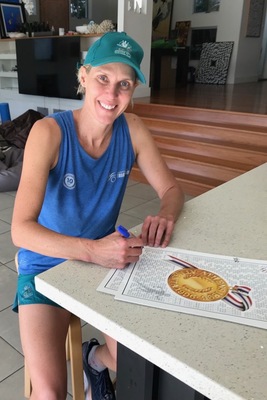
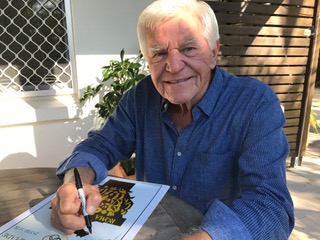
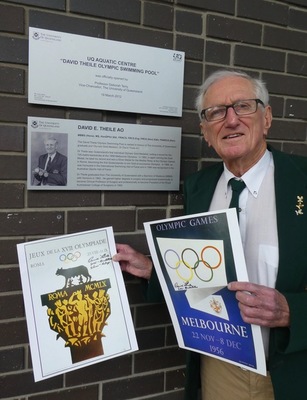
With his contacts in the Olympic arena Ian thought he’d ask a few Olympic athletes if they would sign some of the posters, particularly from the years in which they had won medals.
“One of the reasons I have contact with Olympians is that I had the elite athlete program established,” Ian said.
“Susie O’Neill and Kieran Perkins were in the first year of students.”
The Olympians have backed the project. Olympic swimmer David Thiele, a dual gold medallist in the 1956 Melbourne and 1960 Rome Olympics has signed some posters and so has Susie O’Neill who won gold in both 1996 and 2000 Sydney Olympics.
Olympic gold medalist and Noosa resident John Konrads who won 1500m freestyle at the 1960 Rome Olympics has also signed a few Rome Olympics posters.
The signed posters will be on show and on sale when Ian gives his next Olympic talk which will feature two very different Olympiads.
“The Great Depression clearly affected the presentation of the Games in Los Angeles (1932); the rise of Nazism influenced greatly the preparation and organisation of the Berlin Games (1936). Proposals by several major nations to ‘boycott’ the 1936 Olympics because of ant-Semitism meant that sport and politics came to the fore. Of course, the fantastic athletic performances of African-American (known as ‘negro’ in those days) Jesse Owens and racism in the Olympic Movement will also be discussed, including from an Australian perspective,” Ian said. “With a team comprising 24 Olympians, plus the Rowing Eight, perhaps we should have achieved more than the one medal (yes, singular).”
Ian Joblings Olympic talk on 1932 Los Angeles and 1936 Berlin Games will be held on 23 June at St Andrews Sunshine Beach Church with refreshments from 3.30pm and the talk from 4pm. Cost is $10, students $5. Posters signed and unsigned will be available.