PRECEDE
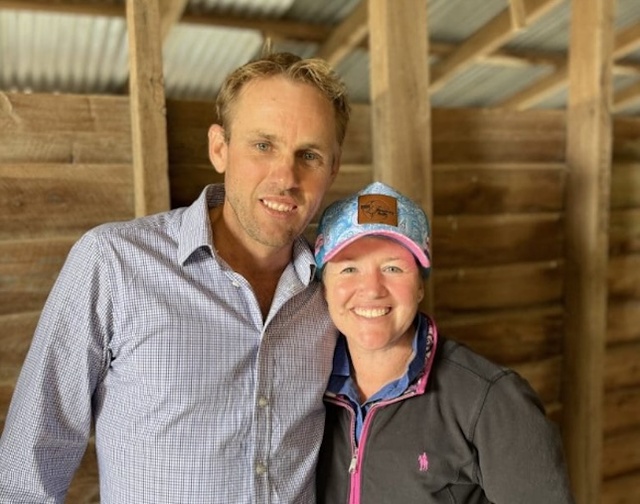
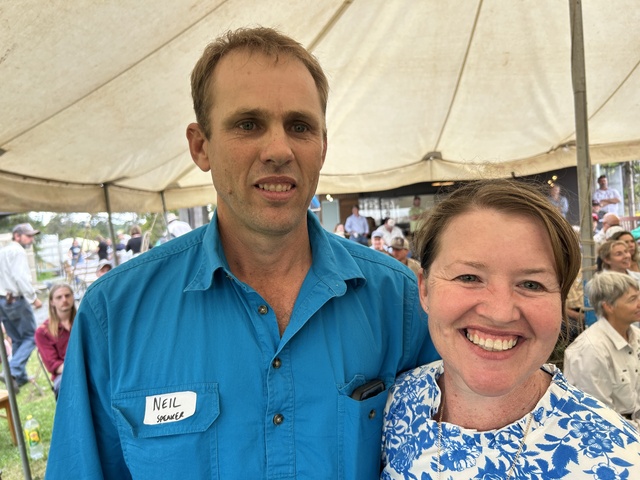
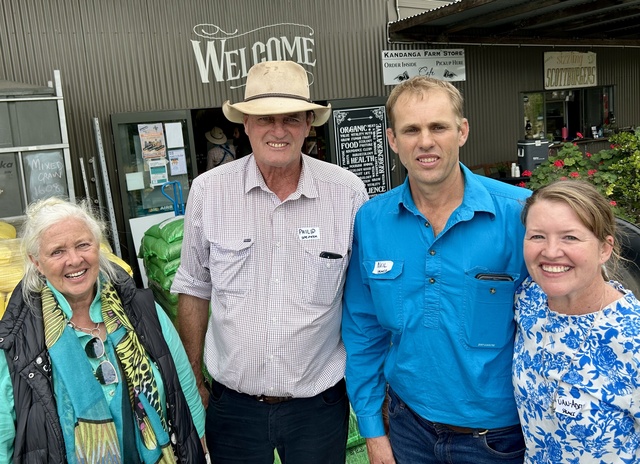
Farming brings enough challenges without the added concern of health issues, as Central Queensland couple Neil and Jan-Adele Reinke have found. Yet they have an unwavering approach to life, as ERLE LEVEY found when they spoke at Agvention 2025 in Kandanga.
BREAKOUT QUOTE
“There’s always positives in every negative situation – you just have to find them and focus on them.”
You are either in or you’re out with life. There are no half measures.
It’s the same with farming, especially when you start down the regenerative agriculture path.
That’s what central Queensland couple Neil and Jan-Adele Reinke have found.
As well as the challenges of converting an 11,000-acre property from traditional farming methods to regen ag, they have had to cope with Neil’s macular degeneration of his sight as well as a broken neck from an on-farm accident.
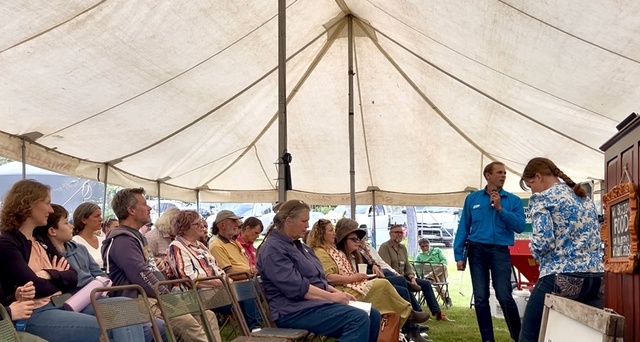
“You cannot be half in or half out,” Neil told a sold-out audience at Agvention 2025 field day at Kandanga in September.
“That’s just being half-arsed.”
Neil has a degenerative eye condition, recent back injuries and a few other things going wrong, but they run more than 1000 cattle.
As well as converting the property to regenerative farming, they are focusing on landscape function, silvopasture and soil health.
Silvopasture is a system where livestock animals, trees and pasture are integrated in a mutually beneficial way. It is a great example of how it can help to work with nature rather than against it.
That’s been important to the Reinkes. Life holds enough challenges without trying to fight nature as well.
Neil is a forester, having worked in Queensland Forestry, managing native forests and plantation establishment.
Jan-Adele has a background in nursing and still works in health.
With silvopasture trial plots on their property they recently travelled to South America to look at systems with Meat and Livestock Australia (MLA), Department of Agriculture, Fisheries and Forestry (DAFF) and Timber Queensland.
“We run a 1800ha breeding cattle operation on two properties in the North Burnett including Granite Creek and Monduran Dam,’’ Neil said.
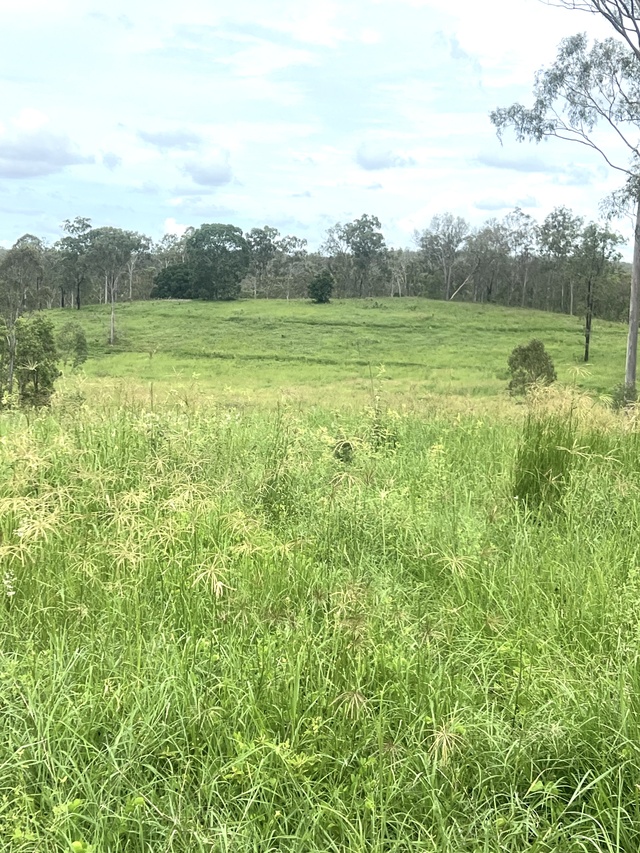
“We’re sitting in a pretty nice position as we have the Dawes Range to the west and an offshoot of it to the east, so we’re sitting in a bit of a valley. Additional rainfall comes in from the coast.
“We rotationally graze our breeder herd but have gone about things a little bit differently to most.
“While they often put their water and wire in first, we’ve prioritised getting our landscape functioning.’’
As a result, Neil and Jan-Adele have received about a 250 percent increase in productivity – this is just from seeing how well the landscape is functioning.
It’s going to be interesting to see what happens when they get their water and wiring right.
“For us, soil health is key,’’ Neil said. “For me, it’s vegetation.
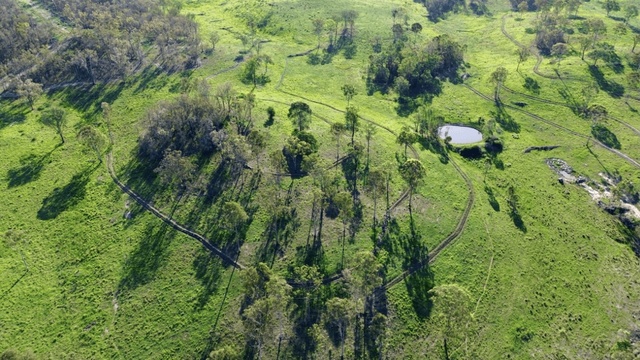
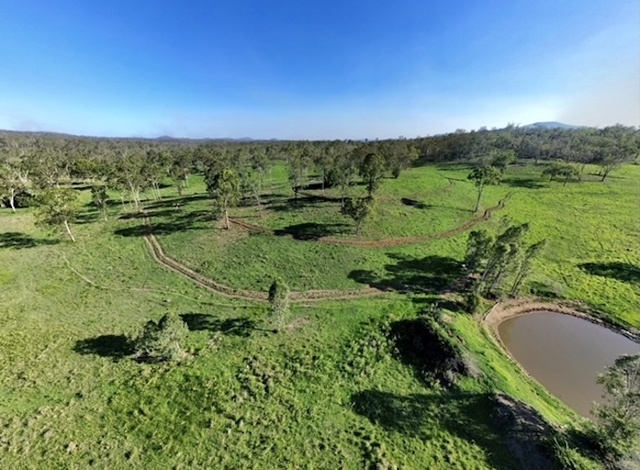
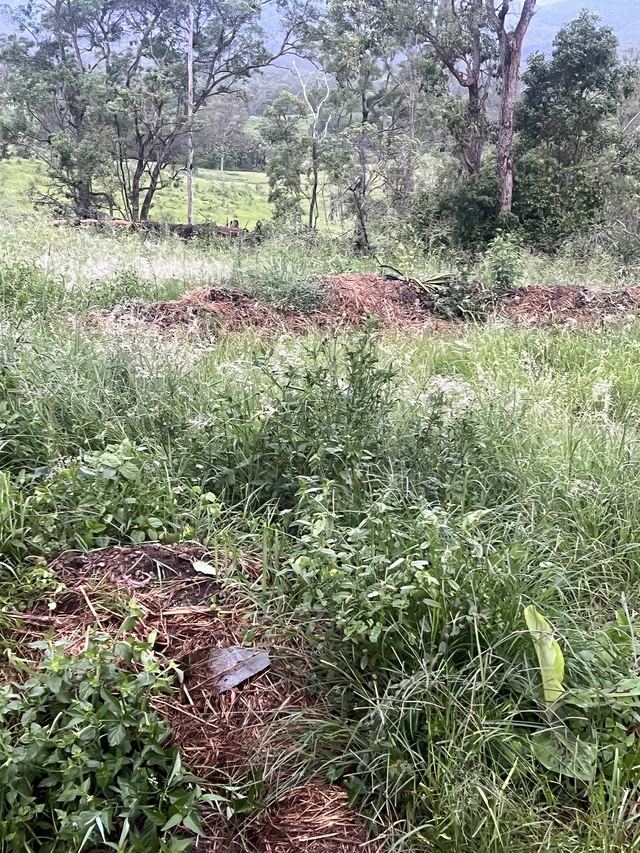
“We put some vegetated contours in with natural steps so they become infiltration areas that feed our grassland systems.
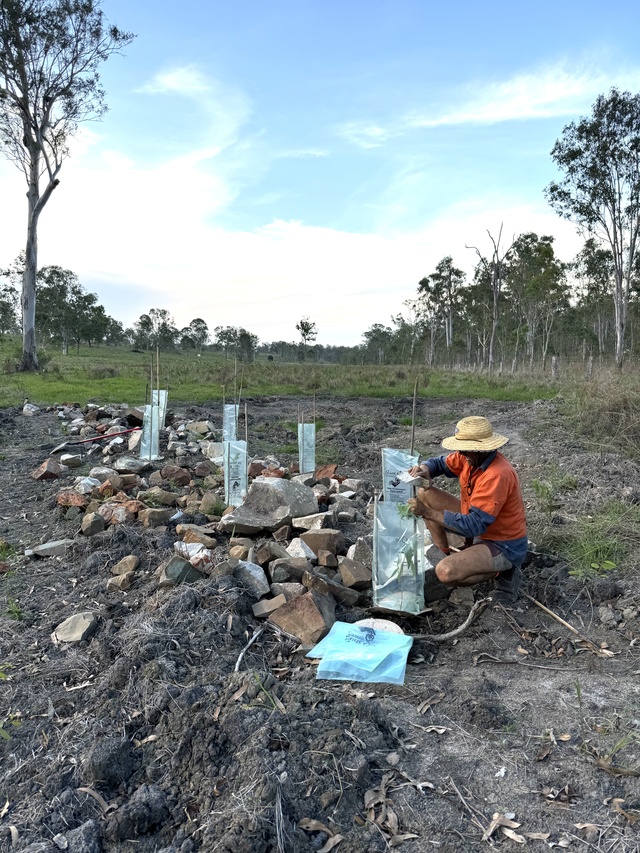
“There’s some contours where we have just been using debris.
“What we found is that when you change that landscape from bacterial soil, which is our grassland, to fungal dominated for the trees, the vegetation is growing at three to four times the speed.’’
By retaining partial tree cover, silvopastures create a more moderated environment that helps mitigate temperature extremes and optimise soil conditions.
The different soil types foster distinct fungal and bacterial communities. In an ideal landscape ecosystem, both play essential roles.
Bacteria provide fast nutrient availability, ideal for establishment phases and high-turnover areas. They offer rapid nutrient cycling.
However, fungi offer nutrient stability, soil structure, and resilience.
For Neil, hydration and water retention are paramount and an integral part of their project to rejuvenate an area of the property.
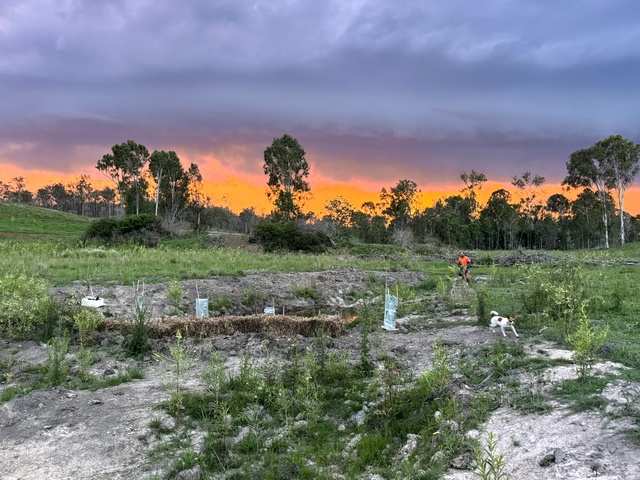
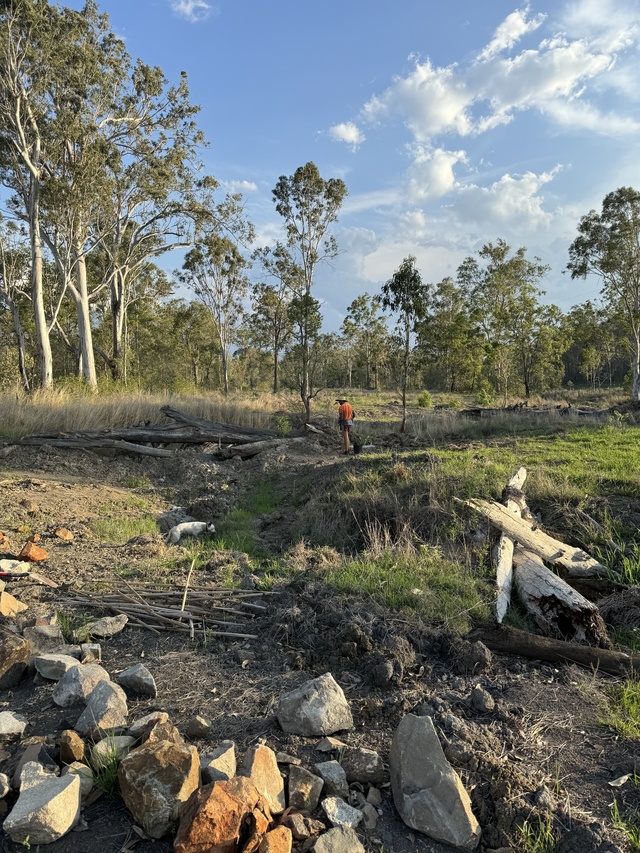
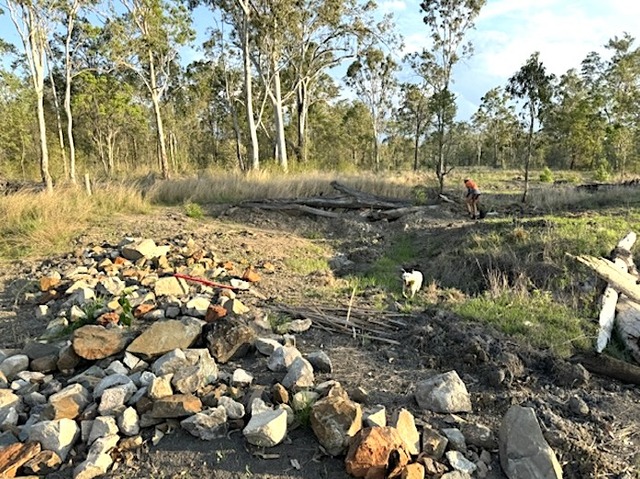
It was a degraded gully system and is now natural wetlands. A few structures have been put in place to help get things happening.
“We’re implementing silvopasture and forestry, including a spotted gum hardwood plantation. When we give grass the right amount of light it will grow with trees.
“Not managed right, we can’t do that. The land is an endangered regional ecosystem type – I guess traditionally it would’ve been cleared and farmed.
“We’re growing timber and pasture. They are actually our most productive sites.
“We don’t get frost in those areas – we get shade, and the grass just grows all year round.’’
The trees lead to cooler temperatures, moderated light levels, and improved soil moisture.
Cattle are shown to have an improvement in their response to heat stress, increased grazing time and decreased standing time for resting and ruminating.
Neil was lucky enough to be selected to go to South America and did about 3600km in a number of countries.
He looked at 10 silvopasture systems and three sawmills.
“They have been doing silvopasture for 30 years with our eucalypts. So they’ve taken our eucalypt from Australia and are showing us what they can do.
“It’s pretty amazing. They do a 20-25m grass alley and about 160 to 250 eucalypt stems per hectare.
“I see silvopasture as a big key to regen ag. We all think about grasses but what is the highest succession plan that we have?
“It’s trees and we can stack to profitable enterprises. We can make farming even more profitable.’’
Neil and Jan-Adele were the Lachlan Hughes Foundation Tree of Life winners in 2023. The award helps them continue as leaders in regenerative agriculture.
The Lachlan Hughes Foundation was established in 2019 to carry on the legacy of the Maranoa cattle producer and “regenerative agriculture” advocate, who tragically lost his life in a farm accident in 2018.
Each year the Hughes family selects 10 young producers from throughout Australia to support their interest in regenerative agriculture. This involves connecting them to professionals for training and mentoring workshops.
“Tree of Life was a pretty big change in what we do,’’ Neil said.
Especially after he broke his neck in a horse-riding accident in 2022 on their property.
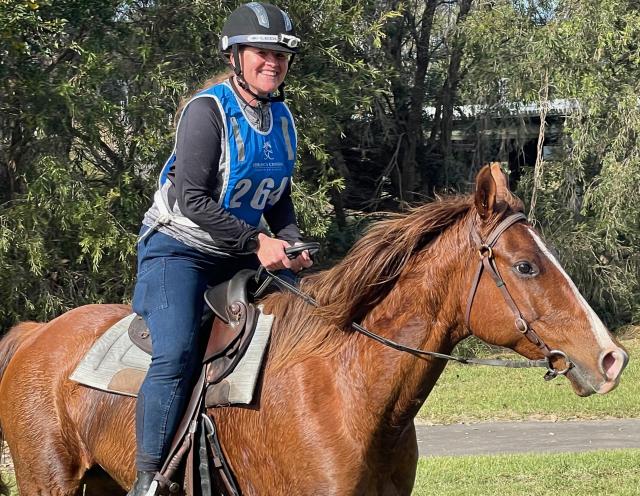
Both he and Jan-Adele are endurance riders and Neil was training two other horses when he hit a slump hole in long grass. That was on top of his deteriorating eye condition.
“I’m slowly losing my sight. I don’t have a driver’s licence so it does create a few problems with farming.
“I get a lot of jokes, especially the one about the charter boat.’’
As for regenerative agriculture – it sort of found Neil and Jan-Adele. Forced upon them if you like.
They bought a rundown farm – one that had a pretty bad history with the banks.
Neil thought it would be great to buy an irrigation property so that in drought times they would still have water.
Like a lot of others in the region, they had red soil and thought it was going to be easy.
“I started learning the hard way. It’s pretty easy to throw cash away.
“I planted multi species, but we didn’t grow too many good ones.
“For us, we had a pretty good lesson. I have a saying that if you’re half in, you’re also half out. And that’s the problem.
“I was half in. I was doing four or five species and getting that same result.’’
It had been a dry winter and hay was at a premium. There were some good spring oats crops and about half had been harvested.
Commitments meant Neil had to go away and by the time he could finish the harvesting a massive hail storm decimated the crop.
Heartbroken and wondering how to make their payments, they did what farmers do – just got on with the job.
“We direct-drilled seed straight into those patches. We did it with conventional type farming and the other we left the mulch on the ground. It was that thick.
“I thought it would smother everything.
“So I made a decision to only put starter fertiliser on the conventional area because I didn’t want to waste money on something that I did not know whether it would grow.
“It was going okay and shoots were starting to come up, so out came the synthetic fertiliser and we chucked it on the conventional area but left the other area alone.’’
“It was slow to start, but it looked good. It was looking green.’’
What happened next came as a surprise – the conventional area started to get dry because there was no vegetable matter in the soil.
They got irrigators on that land but the one with the mulch saw the crop just keep growing.
When it came time to cut the hay Neil and Jan-Adele had produced twice the amount where the organic matter was.
On the recutting of the hay it was back to fertiliser and watering on the conventional area.
By the time it came for the second harvest they had already put three fertiliser applications and five waterings on that conventional area, compared to one watering on the area with organic mulch.
“The yield was twice the volume again and that, to me, was the lesson that it’s all about the soil. A no-brainer isn’t it?’’
But as all things come in farming, the worst drought in the North Burnett in 100 years hit and there was no way a farmer can prepare for that.
It didn’t matter about the amount of multi species that had been planted – that had been done on about 10 percent of the farm. For the rest, it was a matter of watering and fertilising only to realise they weren’t going to get through it.
“I hit a pretty low point,’’ Neil said, speaking how it felt as if he was losing his identity at the time.
“When you lose that and you’re not prepared, it does hit pretty hard.
“With the drought came about a halving of the cattle prices. We were feeding the cattle silage and paying off two properties at half the income.
“I still don’t know how we managed to do it.’’
Taking two-hour power naps in between changing the irrigation was when Neil realised what he was up against.
The doctor prescribed anti-depressants – but Neil never filled the prescription.
“It was my lifestyle choice that was putting me in that position, so we had to change direction.
“It had been a multi-generational farm and because of the drought my dad said he was out.
“At the time, Jan got the offer of a job with Queensland Health so we made a decision to consolidate in one area.’’
In 2019 they moved across to the Bundaberg property and started another part of the journey,’’ Jan-Adele said.
Neil admits he was half in, but also half out – and couldn’t get to where he wanted to go.
So when he broke his neck it was a matter of being lucky to survive.
There is always a positive in every negative, he said, but lying in the hospital Neil saw an advertisement for the Lachlan Hughes Foundation.
While realising he was running out of second chances, Neil got the phone call to say they were successful for the foundation.
“As you can imagine the foundation was a changing point for us,’’ Jan-Adele said. “I feel it starts you on the right trajectory.
“We became part of the regen family, and that meant understanding we were surrounded by like-minded people. People who wanted invest in us, people who wanted to see us succeed and grow.
“The way the foundation works is that part of the program is you have to do a project.
“We quickly learnt it was not so much about the project but the journey that you went on to achieve that.’’
The proposal was to repair an erosion problem on part of the property that had been a problem for the past 50 years.
It was the area where Neil’s horse had fallen and the paddock had not been performing well from a productivity perspective. The water from a seasonal stream was running off the property quickly.
With that in mind they set about the project they named “wetter is better”.
Putting in a contour bank was a big step, but they ended up putting in about five kilometres of natural sequence farming banks.
The fertility in the grass around those banks is really noticeable and the cattle go straight for those areas.
Constructing leaky weirs to slow the flow of water along the stream was another major of part of the project.
It was something Neil had been doing – pushing up logs, lantana, rocks, topsoil and anything he can find to slow the flow of water in the creek.
Hay bales and cane mulch bales were staked in and then vegetation was planted to get them established longer term.
“It has worked well,’’ Neil said, “and was cheap and quick.’’
A rock wall was labour intensive, but really effective in high-flow situations.
Part of of the learning process is regenerating yourself, Neil said. Not just the land. That needs to be kept in the back of your mind.
“We learnt that change is hard,’’ Jan-Adele said. “… and uncomfortable.
“It’s very easy to fall back on what you know.
“Growing up in farming, you learn from your family. If you’re sheltered and you don’t go to field days, you don’t get out and about and you think that’s the way to farm, that’s the way it’s done.’’
Neil believes first generation farmers have things a lot easier because they haven’t been corrupted with ideas.
“It’s like an old dog learning new habits. It’s very hard to drop the old ways. Change is hard – but it becomes habit.’’
For Jan-Adele, it can be lonely because people tell you things will never work. It creates a seed of doubt, and the big learning curve was to get rid of the doubt.
Her advice is to be around those who want to see you succeed and lift you up.
“Regen ag isn’t pretty,’’ Neil said. “People might be having a field day and they worry about how their place looks.
“Mother Nature is not pretty. You don’t expect the prettiest cows, yet they may be the most functional.
“When you start knocking out chemicals and feed inputs it becomes challenging.
“Mother Nature is not tidy. Our landscape was a forest and a lot of people in our area used to spend thousands on chemicals spraying and killing regrowth. We just let it go.
“We use it as a management tool. Those dirty areas become the most productive.
“When I talk about landscape function, those areas look horrible but they are the best, they are producing the best beef.’’
It’s important to remain profitable, Jan-Adele said, or others will take advantage of your hard work when you move on.
“It’s easy to get caught up in the new hype, the new product or gimmick. Remember that Mother Nature has time on her side and doesn’t need a cheque-book.
“Use what’s free and available – work smarter, not harder.’’
The greatest thing is try to mimic Mother Nature, Neil said, explaining how they used to do a lot of cover cropping but learned to tack on behind the weeds and the grasses that were there.
“Utilise it until you get it together. We’ve had plenty of failures, but I like to look at them as expensive opportunities.’’
The project the Reinkes undertook as part of the Lachlan Hughes Foundation scholarship was natural sequencing of the wetland area.
The trouble was the herd size had grown two-and-a-half times but the infrastructure hadn’t kept up. That meant new gates, fencing and stock yards.
“There’s no silver bullet in regen,’’ Jan-Adele said. “You have to do the hard yards. It’s like a marathon not like a sprint.’’
The changes are now showing after five years, Neil said.
“The first three years are the hard years. You’re wondering about what you’re doing and that’s where a lot of people give up. They think it’s going to be easy … they will run more cattle .
“But it’s not like that. It’s longer term. We’re just seeing exponential growth as the soil biology starts to kick in and the hydration starts working.’’
The Reinkes didn’t change their stocking rate at the start.
It was a matter of taking little steps and taking plenty of photos, Jan-Adele said.
“They are a great way to look back to see where you’ve come. There’s always positives in every negative situation – you just have to find them and focus on them.’’
People have been amazed at how the property has changed through the years, Neil said.
In the lead-up to summer he was pulling out the last of the old timber stock yards, and busy concreting a drought-resilient, 1000-ton silage pit. It would serve as a feed bunker for when it gets really dry or for the early weaning of calves.
“Land is your most important asset. You need to match the carrying capacities depending on the season.
“Let’s face it, drought is part of farming. Good seasons are good but in drought these are the processes we need to follow.
“See where the season is going. That’s your business decisions.
“Once you take the stock rate too far you can do a lot of damage to the land. A three-month dry and keeping stock numbers too high for too long can do 12-18 months damage.
“Land is more resilient and can bounce back. When you do regen, that is when you notice the difference.
“In good seasons there is not a lot of difference. But when it becomes tough, you can bounce back.
“That can be done with 15-20mm of rain as opposed to 100mm.’’
Overall, it’s a matter of following the systems that are best suited, Neil said.
“Our systems don’t lie – they tell where you have come from and where you are going.’’
The question is, if you knew you had a degenerative eye disease that would eventually take your vision, would you make different decisions? Would you limit your aspirations?
What if you got on with it but then broke your neck … would you sell up and get out?
These challenges and the questions they raised are what Neil and Jan-Adele have had to tackle.
Giving up was not an option. They are all in, not half out.
Such an inspirational message, especially as we head into the new year.