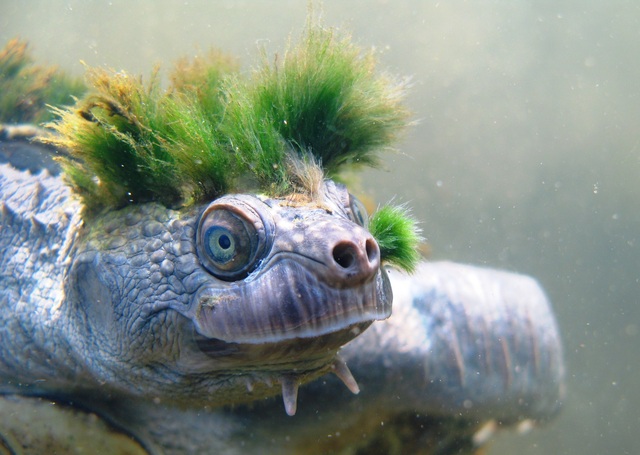
A unique turtle species, famed for its punk rocker hairstyle and wacky breathing ability, needs everyone’s help to survive.
The Mary River Turtle is now Critically Endangered, its future hanging in the balance.
The Australian Government released the new classification early this month.
The turtle is only found in the Mary River Catchment, which spans Sunshine Coast Council, Noosa Council, Gympie Regional Council and Fraser Coast Regional Council local government areas.
Adult turtles may grow algae on their head and shell, leading to the moniker of the “punk rocker turtle” with a green mohawk.
Most outlandish of all, they can stay underwater for up to three days by breathing through special glands inside their cloaca – their rear end.
Sunshine Coast Council runs the Mary River Turtle Protection Program.
The program partners with other councils, environment groups and landholders to remove invasive animals, conduct research and protect turtle nests.
Division 10 Councillor David Law said working with community groups increased the impact of the program.
“Here on the Sunshine Coast, we’re part of a community that cares about our native species and understands how our environment supports all of us,” Cr Law said.
“Working together to strengthen ecosystems in the Mary River Catchment is vital for protecting species like the Mary River Turtle.
“With the nesting season about to begin, this is a critical time for the survival of this very special species.”
The BushCare Sunshine Coast program carries out bushland restoration along creeks providing habitat for the Mary River Turtle, working with dedicated community volunteers.
Council manages 44 reserves in the Mary River Catchment area, including almost 600ha of land purchased through the Environment Levy.
Mary River Turtle eggs are buried in riverbanks, where they are vulnerable to invasive animals.
The invasive European red fox is the most common predator of turtle eggs, and there is evidence of feral pigs also engaging in this behaviour.
According to studies by Mary River Catchment Coordinating Committee, invasive animals eat up to 90 per cent of Mary River Turtle eggs.
Division 5 Councillor Winston Johnston urged landholders to get involved with Council’s invasive animal programs.
“If you have foxes on your property, we can help,” Cr Johnston said.
“That means improving safety for your pets and livestock and protecting all our native animals from this rampant predator.
“Council programs can also help with managing feral deer, feral pigs and wild dogs.”
Feral pigs and feral deer can destroy vegetation and erode riverbanks, impacting water quality and food supply for the river ecosystem.
Meanwhile, invasive plants such as cat’s claw creeper reduce habitat quality, smother plants or even restrict animal movement.
How you can help save the Mary River Turtle:
– Landholders can join Council’s programs to help manage foxes and other invasive species at your place.
– Landholders can join Land For Wildlife to help protect our biodiversity.
– Anyone can join BushCare groups to restore vegetation and remove weeds in the Mary River Catchment.
– You can report priority invasive plants and animals and remove them from your property.