
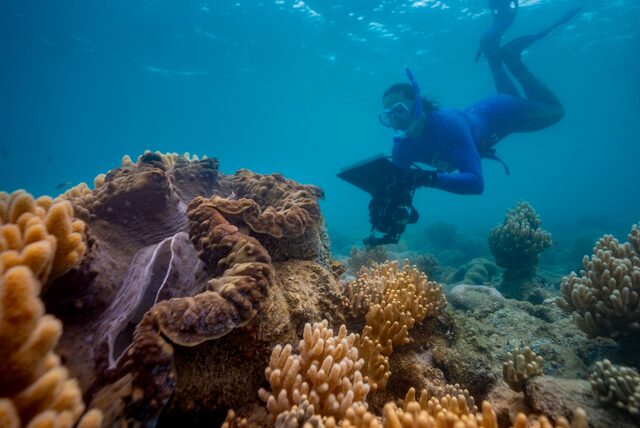
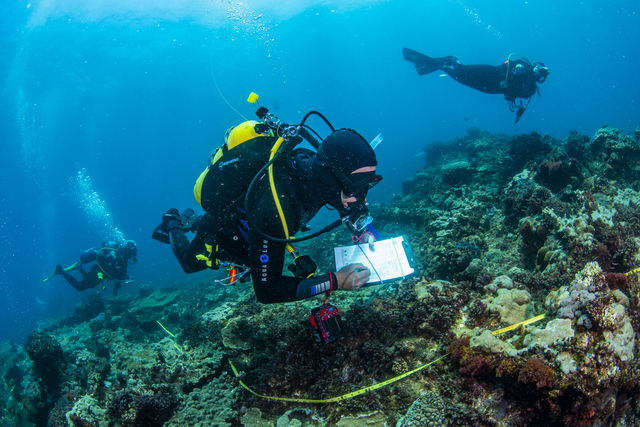
The reefs are in trouble, Reef Check Australia general manager Jodi Salmond told guests at Noosa Parks Association Friday forum, but what does that mean?
“Everything happening on the land impacts the ocean,“ she said.
Main concerns are marine debris, increased flooding effects, more frequent weather events, climate change and the increasing population, she said.
“But there are lots of people interested, doing things and standing up for the planet.“
Jodi completed a degree in marine biology, focused on marine parasitology before working with the CSIRO as an intern looking at parasites and spending a couple of years working with Brisbane Museum then was involved in research with whale sharks on Christmas Island and in Africa.
Throughout her career she has volunteered with Reef Check and on return to Australia resumed volunteering with Reef Check Australia and now holds the role of general manager in the organisation.
Established in 2001, Reef Check Australia is a citizen science organisation dedicated to empowering people to protect our reefs and oceans, Jodi said.
“Primarily we communicate with people, we train people and train recreational divers to monitor the reef for signs of reef health and then report back on that,“ she said.
“We’re the conduit. We’ve got lots of scientists who collect data, lots of citizens, our role is collecting and sharing data which is given to research bodies, Noosa Council, and is freely available on our website.
“Data is used because we have consistent methodologies, consistent ways our data is collected and key volunteers that continue to help us year after year.“
Reef Check Australia is part of a global program operating in 90 countries and recognised as a United Nations official reef monitoring network, Jodi said.
“We can’t fix everything by knowing what’s going on but we can work out what is likely to happen and if there are things we can put in place before it occurs,“ she said.
“Our goal is to collect locally and globally relevant data to show what are our reefs doing and how they compare on a global status.“
Jodi described reefs as important, beautiful nursery grounds for many species. Reef structures off Noosa also provide a barrier, protecting the land from damaging waves, she said.
“There are plenty of threats to the reef. Climate change is going to be the biggest issue. There’s increased severity and extent of things like flooding and droughts, development upstream delivers extra nutrients into the system,“ she said.
“Long term monitoring is important to know what’s happening with these extra impacts.“
Extra nutrients, lead to more algae overtaking coral, but not all algae are bad, she explained.
“Corals are quite particular in what they like,“ Jodi said.
Corals have a symbiotic relationship with microscopic algae called zooxanthellae that live in their tissues. These algae are the coral’s primary food source and give them their color.
If multiple stresses occur, symbiosis between corals and their zooxanthellae stops, leading to the loss of these micro-algae and a rapid bleaching of the coral host.
Jodi said any amount of bleaching seen on an individual coral was recorded as coral bleaching but the amount of bleaching may be only 5 or 10 per cent of that individual coral, so the severity at any time may be quite small.
It’s how coral recovers and if they recover that’s important, she said.
Reef Check began surveying Noosa reefs in 2009 and recent work focuses on the health of Noosa’s Little Halls and Jew Shoal reefs and surrounds, including a comprehensive survey conducted as part of a long-term monitoring program in Southeast Queensland. Following a hiatus of several years, Jodi and her team have revisited these reefs to assess their current condition and compare their status to other reefs across Queensland and Australia. This latest survey provides crucial insights into the state of these vital ecosystems.
She said the program monitors five reef sites in Noosa using a method of mapping out 20m x 5m areas and counting everything contained within it.
We’re looking at invertebrates 10-15 types, impacts (disease, severity and extent of bleaching, debris, damage, snail likes to eat coral, crown of thorns), substrate – what kind of coral, algae, rock, sand, and fish (12 species), she said.
Jodi said they found so much coral at Jew Shoal they mapped out two sites for data collecting. Their findings included a lot of hard corals, some fan corals, massive barrel sponges and overall pretty healthy conditions.
She said in 2011 a massive flood wiped out corals at the reefs which took years to come back.
At Little Halls they found a lot of sponges and soft coral previously found were not there any more but there was a lot of algae, though tests determined it was not a dangerous type of algae that would wipe out the coral.
They also found quite a bit of bleaching, making up about 15 per cent of the coral, and many drupella coral eating snails.
“What does it mean? We can showcase there are changes. Long term monitoring is important to know what’s happening,“ she said.
Jodi said the local Reef Check program included research, education and conservation.
She encouraged people to get involved with Reef Check Australia with lots of options for involvement including reef monitoring, clean ups, drone work or becoming an ambassador to train and educate other people about the reef and ocean.