Precede
The creation of the Lachlan Hughes Foundation to honour the life of a young farmer is making dramatic changes in the lives of others as well as the land. ERLE LEVEY was at the culmination of the year for the 2025 participants and to welcome those chosen for 2026.
It was as much about hope as it was about inspiration. About building resiliency and health into mind, body and spirit as well as into the land.
It brought forward the desire to overcome personal challenges as well as improving the biodiversity in the soil.
The intention is to have a healthy mind and outlook as well as body. To make good choices and enjoy healthy food, to find yourself in a supportive community in order to be the best version of yourself.
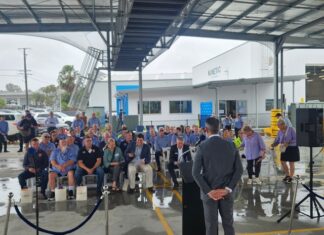
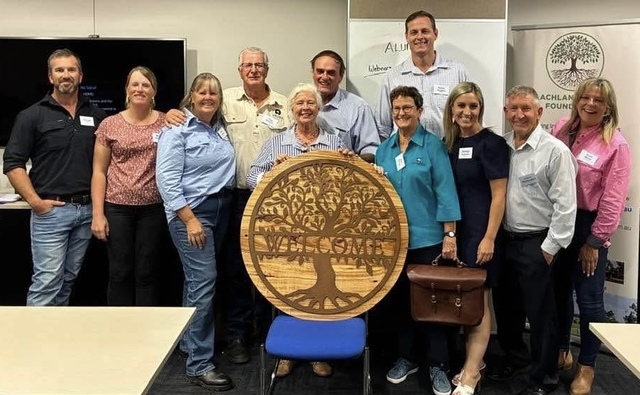
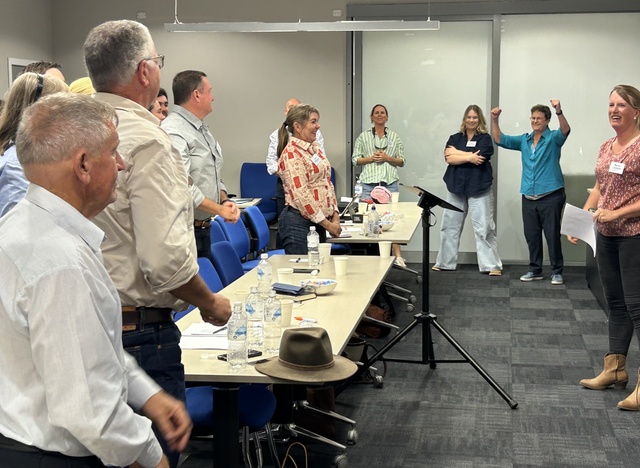
The Lachlan Hughes Foundation’s celebration of the 2025 program and welcome to 2026 participants at Toowoomba was an event to be valued.
The foundation was created to honour the life of Lachlan Hughes, who died in 2018 from an on-farm accident at Dulacca, in the Maranoa.
The vision of the foundation, is: “Improving landscapes and communities by fostering regenerative agricultural thinking and practices.”
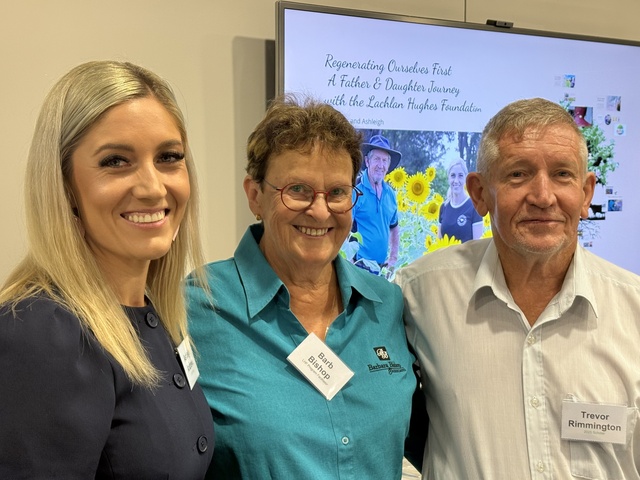
Former participants and members of the foundation were at the Power Tynan office in Toowoomba to support and mentor the 2026 cohort. Members comprised Susie Marro from Mt Bolton in Victoria; Toby and Helen Gilmour of Akuna Estate, near Mudgee, NSW; Tim Lee of Beaulah at Gunnedah, NSW; Martha Lindstad of Karalee at Enngonia, north of Bourke, NSW; Trevor Rimmington and daughter Ashleigh from Lower Wonga in Queensland’s Mary Valley.
What this group of participants showed was the personal growth as well as the improvement to the land that they were farming.
The year involved deciding on a project that would benefit their property, but also provide the ability to share knowledge for other farmers who may benefit.
Lachlan’s vision and passion was to rebuild our soils and increase their sustainable productive capacity to withstand the variables of rainfall. This in turn would revitalise rural communities and improve the economic sustainability of the industry.
Lachlan Hughes always said: “It’s about putting life back into the land.’’
The initial goal of the Lachlan Hughes Foundation was to continue to develop his vision by providing an annual scholarship linking one young land manager with regenerative agriculture professionals for training and mentoring.
After three years this developed into a 12-month program for up to 10 participants from throughout Australia.
The program is outcomes focussed and includes capacity building, personal development, training and mentoring.
At this month’s celebration of the 2025 scholars, a Tree of Life award was made to one participant to enable a further year with the foundation.
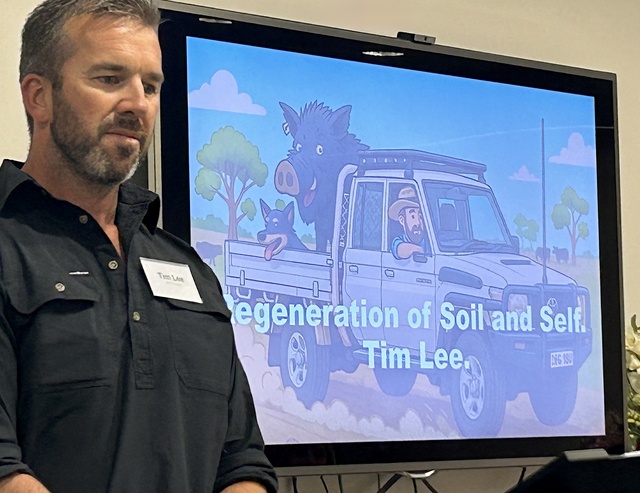
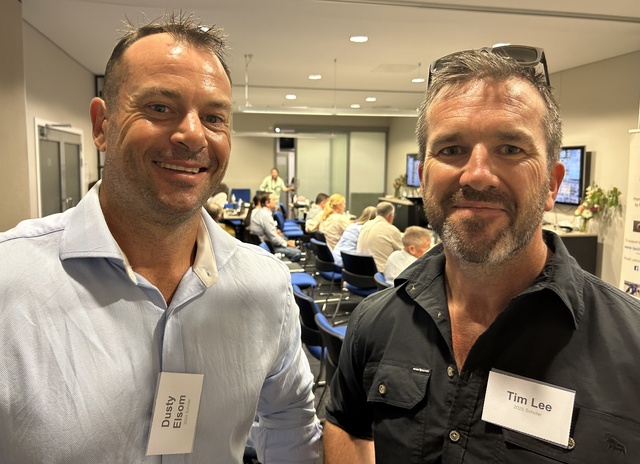
This year it went to Tim Lee, a fourth-generation farmer from Gunnedah in north-central New South Wales – the service hub of the Liverpool Plains.
Tim returned from tours of duty with the Australian Defence Force in Iraq, and later Afghanistan, suffering Post-Traumatic Stress Disorder (PTSD).
Brought on by experiencing and witnessing terrifying events during these military operations, it led to depression and excessive reliance on alcohol.
Tim admits his life was a mess and he was at risk of losing the farm.
“The celebration of the 2025 program was the culmination of the past few years of hard work for me,’’ Tim said at the Lachlan Hughes Foundation dinner in Toowoomba.
“It was a matter of crawling back out from a pretty dark space.”
Looking to several support networks to help turn his life around, including a retreat in Costa Rica, gave Tim the physical and mental reset that was needed.
He turned to learning about healthy and sustainable farming instead of the more traditional methods of the past for grain production.
This included Tarwyn Park Training, permaculture with Geoff Lawton, RCS farming and grazing course, as well as regen ag field days.
Tim attributes his rehabilitation to the time he reached out to Lachlan Hughes Foundation. That gave him a sense of purpose, so much so that his neighbour has now started regenerative practices on a cotton farm.
Tim‘s project was to rehabilitate a wet area that was having salinity problems due to a leaking main dam. Instead of focusing solely on the affected area, he used natural sequence farming methods to create contours and a series of small dams in the higher areas so the water would slowly flow down to the main dam. It was pumped up by solar for the cycle to start again.
The result is highly productive land carrying four head of cattle to the hectare and Tim‘s plan is to concentrate on his beef breeding program.
“The year has been a huge achievement for me moving forward, to be able to share my story and reach people that might need to hear it.
“It was incredibly hard to do – and to be that vulnerable in front of others. But it has allowed me some incredible personal growth.
“The Tree of Life award symbolises that we are intertwined and connected to all living things, to Mother Nature.
“Our health and happiness is a direct reflection of the health of all living things.
“Somewhere along the line, modern humans have forgotten to look after what supports life for us all, our soil, and ultimately our home, the earth.’’
While presenting the changes experienced through the year Tim said he was often told: “It’s not all about the project.“
He admitted that was the easy bit. “I had some pretty loose expectations coming into this.
“I thought by completion I’d have a green sprawling oasis, however, summer in Australia had different ideas.
“I learnt that things don’t happen as quickly as humans would like with nature. It is a slow process for regeneration, but with small wins along the way I could see the way ahead.
“Regeneration isn’t just about the soil, it’s about people, and how reconnecting to the land can heal what is broken.’’
The Tree of Life ceremony was for Lachlan’s parents, Philip and Adele Hughes, and his wife Anna, a chance to reflect with pride on the work their foundation is doing.
“It is inspirational to us all to see the growth in our 2025 program scholars,’’ Adele said
“These outcomes are the result of a team effort and the willingness of all involved to freely give back.
“Tim has an amazing story and the personal growth that we have observed in him is nothing short of amazing – he is a very worthy recipient of the Tree of Life Award.’’
A LONG ROAD FROM NORWAY
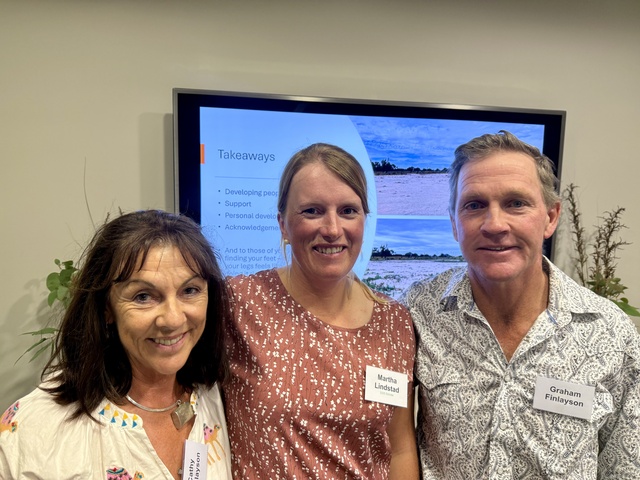
Martha Lindstad grew up on a small farm in Norway but it was a community that did not pay respect to farm life.
A love of horses saw her obtain her riding license but also follow a career in journalism.
That saw her travel to the other side of the world- New Zealand at first and then Australia where she worked on cattle stations in the Pilbara region of Western Australia.
Now Martha manages a 70,000ha time-managed, cell-grazing property for Sustainable Land Management (SLM) at Enngonia – between Bourke and Cunnamulla.
Her project was to show the benefits of regenerative farming by building the soil up and improving the cover crops.
This was in a small section of a large property but resulted in much-improved weight gains in the cattle, better ground cover, and less compaction of the soil.
The project site produced more new varieties of grasses and plants than the control site.
“It proved that good grazing management is critical for nutrition in plants – you are not necessarily reliant on rainfall if your soils are functioning.’’
There was a massive difference in the brix readings in plants, indicating the levels of dissolved sugars and minerals.
The project site improved microbiology, there were more minerals, more organic carbon and organic matter.
Water infiltration improved from the start until the end of the project, the soil softened and the penetrometer went deeper down than before grazing.
“This program doesn’t just develop skills, it develops people. And that’s what it’s done for me.
“Change doesn’t happen when you’re ready, it happens when you are supported.
“This journey isn’t about becoming someone new. It’s about becoming more capable, more grounded and more willing to back yourself.
“To those of just starting the program or still finding your feet – trust the process.’’
A CLEAN, GREEN FUTURE
Susie Marro from Ballarat in Victoria is continuing a family history of farming – first at Edenhope on the South Australian border and now at Mount Bolton.
She pays tribute to her father, who had a merino sheep farm as well as cross-breeds, and to her grandmother who ran a small dairy farm on her own
“My father ran two to three sheep to the acre. When he died aged 82, I planted as many poplar trees in remembrance – and used his old set of harrows for my project.
“I’m a collector of cattle. Regen farming is the future, and I want to be part of a future that is clean and green.
“Unadulterated food is the way to survive. Look after the soil, and the soil will look after you.’’
Susie wanted a deeper understanding of natural soil composition – to explore multi-species plantings and leave land in a better place.
What she learned from the program was to constantly expose yourself to hardship.
“There is no growth in a comfort zone.
“Regeneration starts with observation … observe the land, the trees and the soil. Improved soil structure retains moisture more effectively during dry periods.
“I’d be broke if I kept going the way I was. I have not had to buy hay for six months.
“There is less outlay and I run fewer cattle but they show a higher weight gain.’’
The advantages of planting multi-species is they build organic matter, Susie said. Diverse root systems and plant residues contribute to increased soil organic matter content.
A diverse mix can see legumes for nitrogen, grasses for root systems, and brassicas for minerals.
It is important to allow the roots of plants to feed others.
“Comparing multi species to single species showed a huge difference in regard to thickness of the ground cover. The single species was more sparse.
“The Lachlan Hughes Foundation is a program that has no boundaries but allows you to believe in yourself. Once you do that, you can fly.
“For the bird to fly, it has to test its wings.’’
LOOKING AT ALTERNATIVES
Trevor Rimmington and his daughter Ashley Andrews from Lower Wagga in the Mary Valley took on a 200-acre property that had been conventionally grazed over the past 200 years.
It was at a time that Trevor was recovering from invasive cancer so their efforts were to immerse themselves immediately into regenerative farming. This was to rehabilitate the soil but also to provide a healthy lifestyle for Trevor and the family.
They have supplemented their income with farm animal tours featuring Highland cows as well as goats, sheep, cattle and pigs. That will expand into soil and wildlife conservation.
Their project was to fence off four plots from 10acres – next to each other then to treat them differently.
One was left as a control plot and simply had compost applied.
The others were planted with different cover crops as well as being treated with a variety of compost and manure mixes.
The results surprised both Trevor and Ashley but generally in a good way.
Microbial sprays were spread on some, but not all plots, and they all got compost.
Where there were trees and shade, when the weather started to get hot they had better crop growth.
“We will plant more trees on fence lines or install fences where the trees are,’’ Ashleigh said.
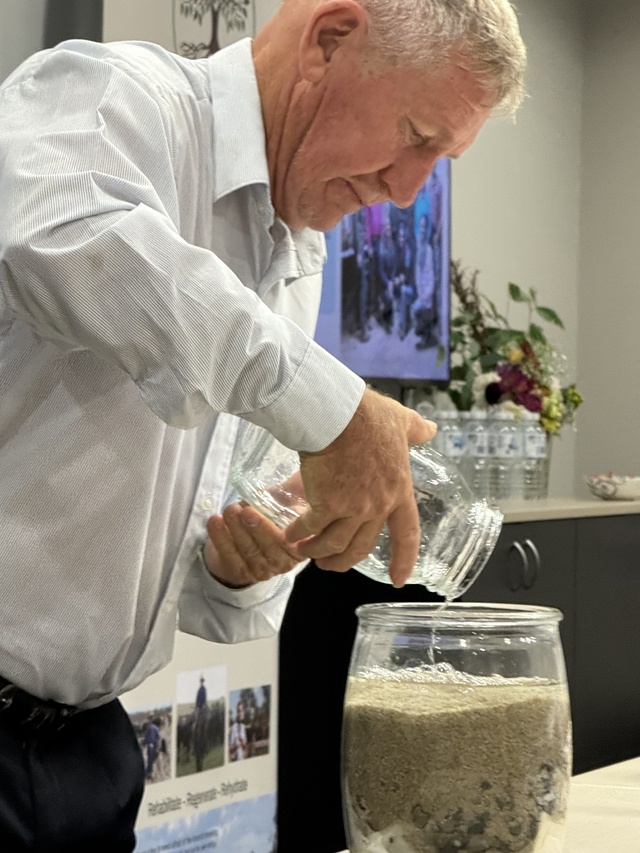
Trevor demonstrated the timeline of the project by placing rocks in a jar, then sand and finally water.
The jar was able to be filled because each layer was added in the right order.
“Look at something and try to understand why,’’ he said.
“You are what you eat. At shopping centres, do you look for a healthy alternative?
“When we start thinking, we don’t know where most of the food comes from.
“It pays now to look for a healthy alternative.’’
Trevor’s experience is a reminder that programs such as this reinfoce the opportunities for learning that can be personalised for the individual.
“Regenerate yourself – whatever makes you uncomfortable is your biggest opportunity for growth.’’
ACCIDENTAL FARMERS BRING GROWTH
For Toby and Helen Gilmour of Akuna Estate, near Mudgee in the Central West of New South Wales, the year has seen them go from “rookies to contributors’’.
Their presentation highlighted the personal growth in their personalities – both individually and as a couple. It also showed that it pays to be open-minded in a farming life.
They came from professional backgrounds – Philip is an electrical engineer after being with the Royal New Zealand Air Force; Helen took on a number of businesses to manage after a career in haematology, focused on studying, diagnosing, and treating blood diseases.
After looking for a Seachange at Port Stephens, they sought for a Greenchange and moved to Mudgee.
Initially they were looking for six to 100 acres to establish a holiday hideaway experience for people as they had enjoyed success in that on the coast.
However, that became 200 acres of rangeland that was covered in bracken fern and timber.
Catastrophic bushfires changed the landscape dramatically but the house, sheds and infrastructure survived.
They continued to pursue holiday experiences but their attention switched to what to do with the land.
Attempts to put carbon back into the soil after the bushfires was having limited success.
They wanted to improve land at the bottom of the property by building contours and spreading the water out, Helen said.
“We became accidental farmers and realised we needed to be good stewards of the land
“It needs a lot of work. We came to fix a problem.’’
Instead, they discovered more about personal growth than microbes and soil, Toby said.
“The whole process improved a lot of our life.
“We had huge amount of imposter syndrome and were struggling to find purpose. Anyone can raise chickens and manage holiday stays.’’
During the year they changed focus with support from the Lachlan Hughes Foundation.
Philip Hughes from the Foundation, and a cattle grazier from Queensland, suggested they switch to a flower farm.
Accordingly, their first two-acre test plot has proven very successful.
By using woodchip from milled timber on the pathways and organic garden mix as well as biochar from the forest fire, they have re-energised the soil and inhibited the noxious bracken fern.
Even the chickens contribute by adding to the fertility of the soil with their manure.
Toby and Helen maintain that the year with the Hughes Foundation and their time on the property have meant more to them than the previous 35 years together.
From nine flower garden beds they intend to create 62, and that will build an income stream for the quiet part of the holiday season.
“Preparation and timing matters,’’ Toby said. “Observe and determine what the market wants.
“One year ago we didn’t know we’d be farmers, let alone flower farmers.
“Who knew we would be given advice from a cattle farmer.
“It comes down to being willing to change and take advice.’’
THE CLASS OF 2026
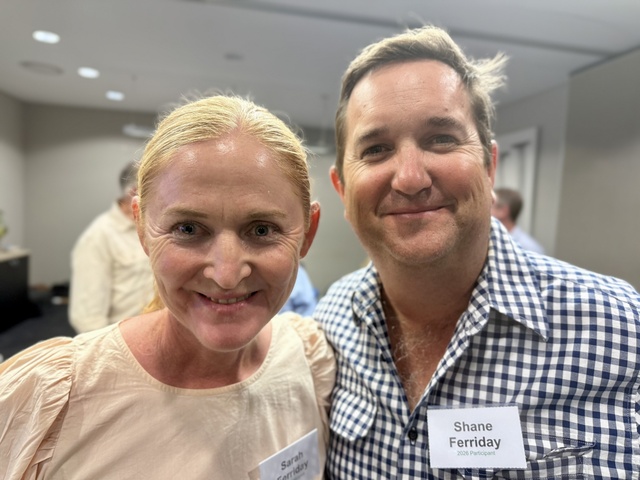
Lachlan Hughes Foundation scholarships for 2026 have gone to Roy and Ella Baker from the Shoalhaven area of NSW; Jessica Strohfeldt from the Barkly Downs in the NT; Lisa Williams and Brad Dorge from the Boyne Valley in Central Queensland; Shane and Sarah Ferriday from Hodgson, near Mitchell, Qld; Georgie Coombe and Jack Caskey from Begonia, south of Roma, Qld.
Foundation trainer and facilitator Barb Bishop, in welcoming the new participants, commented on the diversity, and the success of the program through the years.
“The people have grown … so have I. This is a program you will engage with for years.
“In the 12-month part the course there is room for a lot change.
“It starts right now, with the opportunity to introduce yourself to a group.
“If you work as a pair or couple that makes it quite different.
“You are telling your own story yet telling one story.’’