
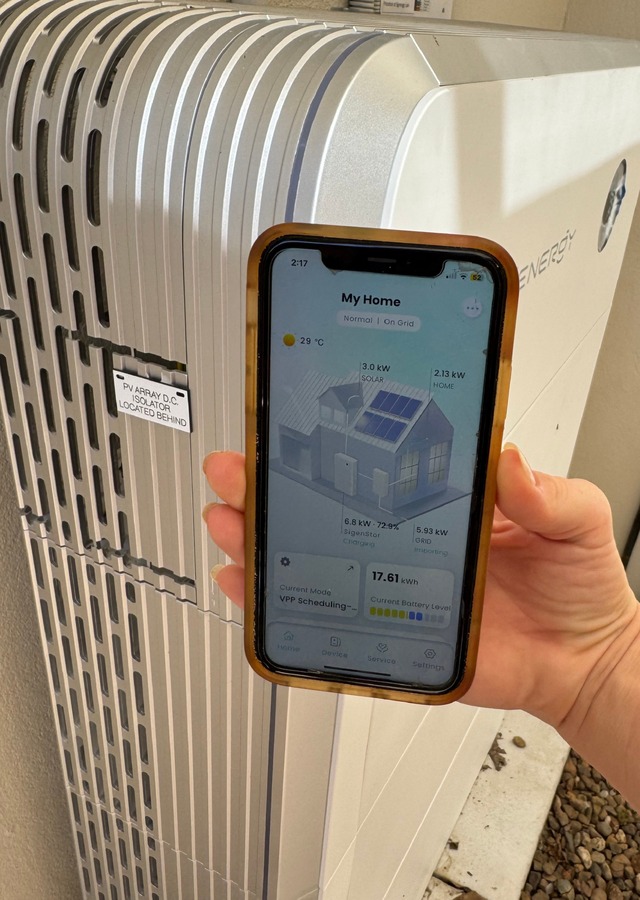
When Andrew and Jenny moved into their new townhouse in Tewantin in late 2025, one of the first things they did was install solar panels and a battery.
“We wanted to reduce our carbon footprint, cut our power bills and make better use of Queensland’s sunshine.” Andrew said.
“Because our townhouse roof was too high and complex for installers, a smaller system on the carport made sense. It gets direct sun for most of the day, and on a bright summer’s day we generate over 24 kilowatt hours of electricity.
“We use roughly 7kWh a day when we’re not charging our EV, so even with a modest system we produce more power than we consume. The real game changer, however, wasn’t the solar panels — it was installing a 24kWh battery, made affordable by the federal government’s Cheaper Home Batteries Program.”
The rebate, delivered through the national Small-scale Renewable Energy Scheme, provides an upfront discount on eligible batteries. Installers apply it directly to the purchase price using Small-scale Technology Certificates (STCs), so households don’t have to navigate a separate claims process.
When it launched in July 2025, the discount was worth roughly 30 per cent of a typical battery’s cost.
The response has been extraordinary.
By early 2026, well over 150,000 households across Australia had installed batteries – far higher than early forecasts. Demand has been so strong that the federal government has announced significant changes from 1 May 2026 to ensure the funding lasts through to the end of the decade.
From May, the value of the rebate per kilowatt hour will step down more quickly, with reductions scheduled every six months. Larger batteries will also receive proportionally less support per kWh than standard household-sized systems.
The aim is to spread the funding across more homes rather than having early adopters capture a large share of the subsidy.
In simple terms: batteries will still be supported, but the incentive will gradually shrink over time. For households considering installation, timing and system size now matter more than ever.
As Andrew explains. “For us, the battery opened the door to something even more powerful — joining a Virtual Power Plant (VPP).”
A VPP sounds complicated, but it’s essentially a network of home batteries digitally linked together and coordinated by an energy retailer or platform.
Instead of each battery operating alone, hundreds or thousands act collectively like a small power station. When demand spikes and the price of electricity increases — typically between 5.30 and 8.30pm – the VPP can discharge stored energy back into the grid.
When wholesale prices are very low, often during sunny or windy periods, it can charge batteries cheaply.
“Through our VPP, our system automatically buys and sells electricity at wholesale prices on our behalf. During the day, our panels charge the battery.
“If grid electricity becomes extremely cheap, the system may even top up from the grid. Then during the evening peak, when prices rise, the battery sells energy back at a premium.”
“It feels a little like having a tiny share portfolio — except we’re trading electrons instead of shares.”
“Our first monthly bill has just arrived: $35, covering supply and net usage charges. We expect this bill will reduce even further when we – and our VPP – have learnt how to manage our power to maximise the benefits of buying and selling stored power.
“Even charging our EV using solar, we estimate we will save thousands of dollars a year”.
Of course, batteries remain a significant upfront investment, even with rebates. Not every home has suitable roof space, and rental and strata properties face extra hurdles. But as costs fall and policy increasingly rewards storage and grid participation, batteries are moving from being a niche add-on to a mainstream energy upgrade.
“For us, the rebate made the battery achievable. The VPP makes it financially dynamic”.
If you would like to learn more or get involved in local energy initiatives check out zeroemissionsnoosa.com.au or email info@zeroemissionsnoosa.com