By Phil Jarratt
SITTING in a tea plantation mess hall on a ridge above the high hill station of Ella, Sri Lanka, last week, sipping a weak green tea for which I had paid the equivalent of 10 bucks, or about 20 times its value in the village 100 metres or so below, I was reminded of the words of the travel writer Pico Iyer – this generation’s Paul Theroux – in his excellent essay, “Why We Travel”.
He wrote: “We travel, initially, to lose ourselves; and we travel, next, to find ourselves. We travel to open our hearts and eyes and learn more about the world than our newspapers will accommodate. We travel to bring what little we can, in our ignorance and knowledge, to those parts of the globe whose riches are differently dispersed.”
These are my go-to words when I find myself sitting in some far-flung joint on a gloomy, sticky, grey kind of day, wondering what the hell I was thinking when I put this one in the travel itinerary.
Oh, that’s right: we’re here to lose ourselves, then find ourselves again.
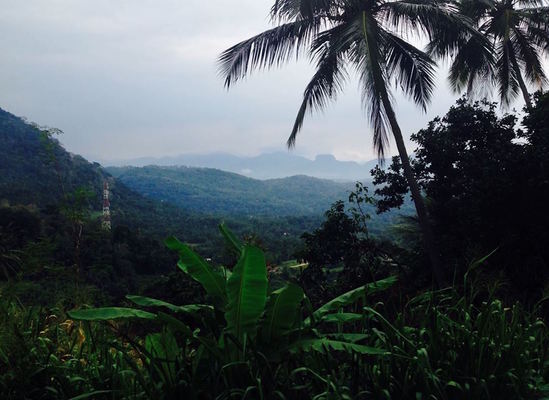
But my cynicism is only skin deep, and the Hill Country of Sri Lanka is, in fact, a place whose riches are differently dispersed, and perhaps just that little bit harder to discover in the damp mist of a building monsoon.
So Ella was our first stop in the hills, the point where we picked up the train to wend out west, eventually to Colombo, to finish our journey.
It’s a bit like Byron in the ’70s, which is to say a bit rough around the edges but not without its charm.
We found only one memorable restaurant, a place where the local food was as good if not better than anything we ate in all our Sri Lankan travels. The only problem with Matey’s Hut is that there are just three dodgy sawcut tables suspended in a tree-house, and the place is hugely popular with young people of the kind who try to bargain down the price of a third class train ticket.
But when we did beat the crowd and got settled in a corner, the meal was sensational, the highlight being a mango curry.
Matey and his family were delightful hosts, although when I pulled a chilled bottle of Chilean chardonnay out of my backpack and asked for an ice bucket, they gave me the who farted look.
I promptly withdrew the bottle and we drank fresh lime with soda instead.
Oh, and about the tea plantation tours, which are rife up here.
Tea, sure. After I’ve already had three cups of coffee I’ll give it a go, but do I really need to don a face mask and booties to learn the mysteries of tea leaf production.
Apparently they pick it, dry it, crush it and package it. Who knew?
All of Ella was a construction site, including our humble hotel, where we had to clamber around the workmen’s ladder to get to our room, and where the hammering and drilling was ceaseless from dawn to dusk.
But after a dramatically beautiful ridge-top train ride, we discovered that Nuwara Eliya, or “Little Britain”, was just the same. It seems that since the end of 30 years of civil war, Sri Lanka has awoken to its own tourism possibilities, and maybe just overcooked the goose a little, like so much of the Third World before them.
We stayed in the Glendower Hotel at the cheap end of Grand Hotel Drive, the Brit-strip that runs along the edge of the golf course.
In the late afternoon we checked on what we might have been missing, first at the Grand, a truly superb example of planter kitsch, and then at the exclusive Hill Club, where a man called Benedict, dressed in a maroon topcoat, first tried to throw me out, then tried to rent me a tux so I could get in for dinner.
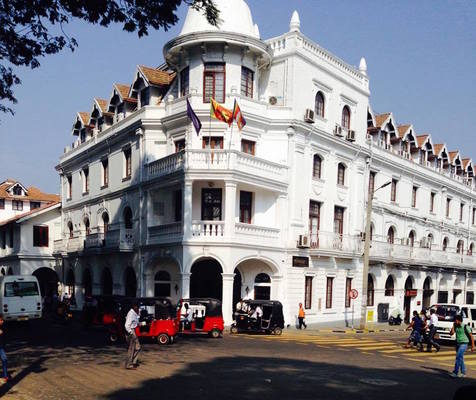
Another majestic train ride brings us to the royal seat of Kandy, a truly beautiful small city, built around the edges of a man-made lake. We checked into the city’s landmark Queens Hotel, on the edge of the lake and just a couple of hundred metres from the Temple of The Tooth, where the only known relic of the Buddha resides.
Our first morning in Kandy we strolled around the lake before breakfast, finishing the walk at the British Garrison Cemetery, just up a steep hill from the cultural centre. It was still early and the gate was locked, but soon enough Assistant Caretaker Harsha Kumara Herath came running up the hill to let us in.
He was a smart, talkative young man who explained the colonial gravesites to us while breaking away to whippersnip the weeds.
After standing on the grave of John Spottiswood Robertson, the last European to be trampled to death by a wild elephant in Ceylon, and telling us the history, Harsha invited us to view the cemetery museum.
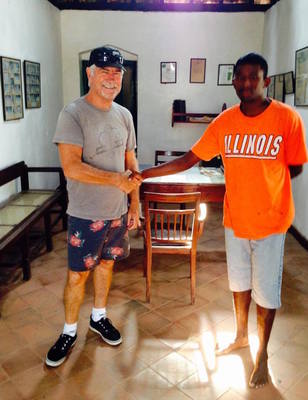
Inside the small room he pointed to a photo of HRH Prince Charles at the cemetery, with him in the foreground.
“I shook the hand of Prince Charles,” he said proudly. “But he has very big ears.”
I shook the hand of the man who had shaken the hand of the Prince of Wales, explained about the degrees of separation, exchanged emails and promised to keep in touch.
There is much to love about the people and culture of Sri Lanka, and for me the Assistant Caretaker of the British Garrison Cemetery summarised it all.