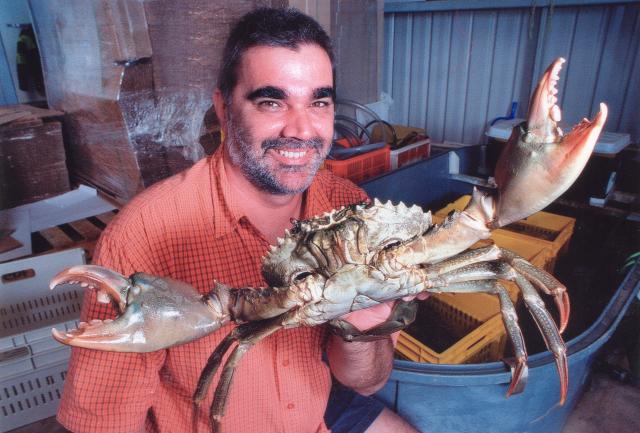
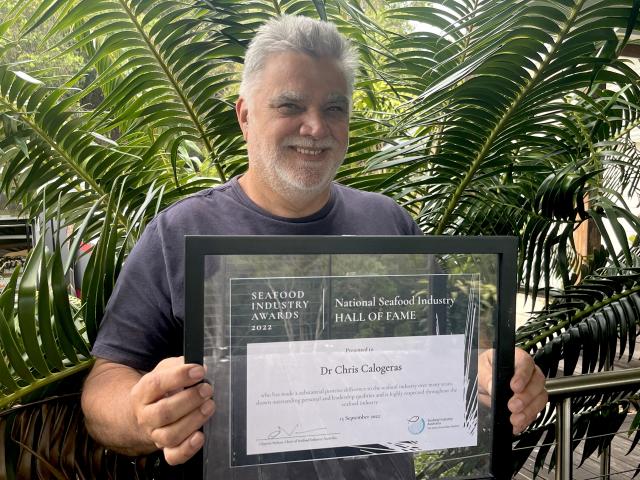

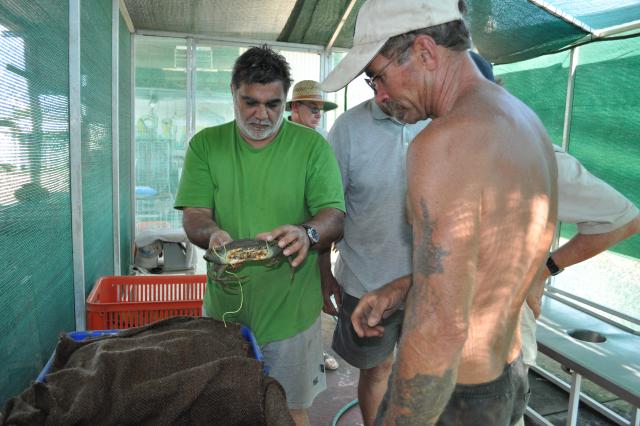
Possibly the least-known outcome of the long grind of inquests and trials in the Lindy Chamberlain case which dominated the headlines throughout the 1980s is that it inspired a Cooroy man to begin a storied career that has seen him recently inducted into the National Seafood Industry Hall of Fame.
Don’t get the connection?
Nor did Noosa Today, until Dr Chris Calogeras, one of Australia’s leading experts in wild harvest resource management, explained how a knockabout kid from Fremantle, travelling overland to Indonesia, fetched up broke in Darwin and found a job in the Justice Department ferreting through mountains of forensic evidence, most of which would eventually be disproven.
Chris recalls: “I was fascinated by the science, the collecting of evidence, running assessments and analysis and then making determinations. It was exciting. So I went back to school and got a diploma in environmental science while I did a traineeship in the Northern Territory Fisheries department.”
Although there was plenty of fish eaten at the Calogeras Greek family home, Chris wasn’t particularly passionate about catching them, and certainly didn’t foresee a career in the industry.
But one too many sweltering 36-degree days putting ceilings into Darwin’s new hospital to pay the rent and he rang a mate to see if there was a job going in the public service.
Thus began a journey of nearly 40 years that took him to the seafood industry’s highest accolade.
When you look at Chris’s career path, it’s not hard to see why.
Working within government for the first 20 years and as an independent consultant for the second, he epitomises the kind of approach that has taken fishing from a cowboy operation where anything could, and did, happen, to a responsible, economically and ecologically sustainable industry working closely with First Nations communities.
But the first job to be done was to lay down some rules.
Chris recalls: “The very clear message I got early on was that you have to look after the resource but it’s also about managing the behaviour of people.
“With a couple of colleagues, I invested myself in the people side of the fisheries industry, building relationships that allowed us to put in place a lot of the hard decisions that were needed in the NT in those days.
“There was too much fishing, so we had to be prepared to go and have them yell at us until they calmed down and we could negotiate. The reality at the time was that everyone could get a license and you just went out and caught fish – mullet here, barra there, crab over there.
“But the economists thought this was incredibly inefficient, that the crabbers should catch crab, the barra fishers catch barra and so on. Imposing that meant fishermen had to make life choices, rather than being simple hunter-gatherers, which led to some very heated discussions.
“It was hard, but I’m still mates with quite a few of them.”
During his time with the Territory Justice department, one of Chris’s jobs had been to accompany magistrates to court sittings in remote Aboriginal communities, and he had developed a rapport that helped as Fisheries began to deal with the prickly issue of Native Title over fishing grounds.
He says: “At Fisheries, the first thing we focused on was maximising catch and then maximising sustainability, looking at the by-catch and threatened species.
“Next, we looked at the people who were there first.
“It took a while to happen, but by the time I was nearing the end of my government time, we were setting up programs to work better with the Aboriginal people. We had to look at the traditional fishing grounds and work out protocols for their use.
“In those days some recreational fishermen would ask permission to fish a certain area, but most didn’t.
“Commercial fishermen often did and made some sort of deal to share catch. But the legislative position was very weak until after Mabo and Native Title.”
At the start of the new century Chris decided to strike out on his own with a consultancy firm he called C-AID.
Much of the new firm’s early work was in negotiating with and for First Nations communities.
He recalls: “I’d been working a lot with mud crabbers who were mainly Viet and Cambodian refugees, so I took on a contract with a big export company which was looking to access Aboriginal land for crabbing.
“I’d go out to the communities and start the negotiation process. I went to amazing places and met amazing people.”
The job also led to a connection with the Northern Land Council and the Blue Mud Bay court case which was a game-changer in First Nations fishing rights, often described as the High Court’s most significant land rights ruling since the Mabo case led to the creation of the Native Title Act.
Says Chris: “I led a group from the NLC on a research trip to New Zealand to see how the Maori had navigated their way through similar rights situations. That was really my beginning in doing a lot of work on important Indigenous fishing projects, and it’s carried on from there.
“It became really clear that there was a gap [between Indigenous and European fishing], and the Fisheries Research Development Corporation decided they would fast track investment to try to close it, so they set up the Indigenous Reference Group.
“That program has been running for 10 or 11 years and it has led to many policy changes – often subtle, no sledgehammer – and we’re now seeing each state and territory putting in place Indigenous work programs within their structure.
“None of it is easy.
“There are massive challenges but a lot of the change that is happening has come from the work of the IRG.”
Chris now serves on the board of the Fisheries Research Development Corporation where two of his pet projects are creating a broader understanding of sustainability and fostering more research data through recreational fishers.
He says: “In fishing, without sustainability you have nothing.
“But what is sustainable for an Aboriginal person might be quite different from the European model.
“For example, if someone in the industry is researching fish stock in a certain area, he might determine that it’s fine, but an Aboriginal might say, it’s not fine if I can’t catch a tailor for dinner out front of my place.
“Unless you have the right people in the room who can examine every aspect of sustainability, we’re always going to be in trouble.
“When I started in the industry the idea of sustainability was that you needed to make sure you could catch enough to make money.
“Now it’s about are we protecting the habitat, are we protecting the species, is the ecosystem being properly managed?”
Taking a deep breath, he says of the powerful recreational fishing sector: “In many fisheries today the recreational proportion of the catch is greater than the commercial. Snapper in southern Australia, barra in the NT, for example.
“Commercial fishing is organised now, operating under strict rules, often boat cameras in place, satellite observation.
“With recreational fishing there’s a broad spectrum from the casual to the committed and no data for modelling for better economic, social and ecological outcomes. We know to the kilo what and where the commercials are catching, so what are the recs catching?
“Too often we don’t know, so in the future I think there is going to be greater responsibility placed on recreational fishers to manage themselves, with government assistance.
“I think it can be quite a light hand, perhaps a licensing system, a data collection program like the commercials have.
“I think most people who fish are good stewards because they want to keep utilising the resource, but it might be they need better education about why there are no fish, rather than just blame it on commercial operators, of whom there are far fewer today than 30 years ago.”
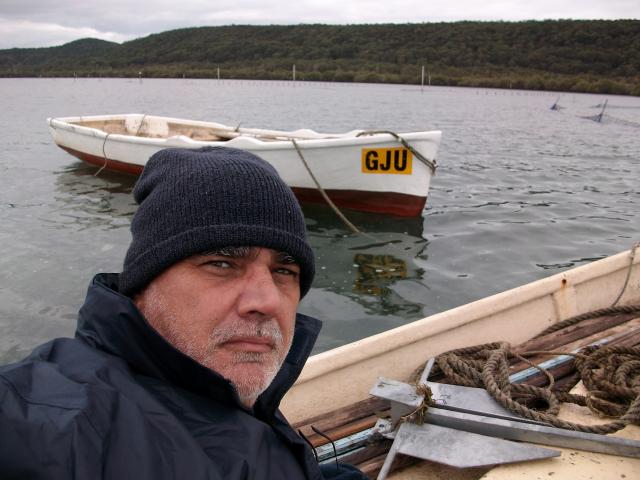
Having lived in Noosa Shire for 12 years now, Chris has watched with interest the debate over the restoration of the Noosa River, although the majority of his work is on national projects.
He says: “Habitat is everything and it needs to be managed, which is why the oyster bed regeneration is a good idea.
“I hope they’ve done their homework on how it’s been installed, but it has worked in several other places and should work here.
“The real problem for the Noosa River is that around the estuary there is very little native vegetation.
“It’s been developed out. The things that influence fish stock start with habitat, then pollutants, then climate, then migratory impacts.
“The commercial fishing pressures are nothing like they were years ago because there’s no fishing fleet here anymore, so fish stock can be improved.
“The FRDC is working with groups like OzFish on a variety of habitat enhancement projects, and hopefully there will be more in the future.”
While Dr Chris Calogeras and C-AID are still going strong, induction into the Hall of Fame has made him reflective about his many achievements in the fishing industry.
“I guess I’m most proud that I can look back on the number of people I’ve helped find their right place in the industry, which aligns with my philosophy of trying to make myself more redundant by building skills and capacity around me.
“For a consultant, that might be a bit dumb, but that’s the way I like it.”